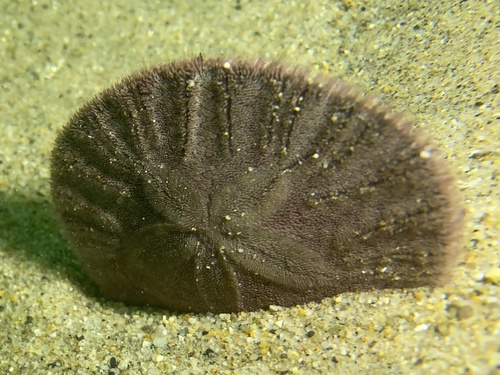
About Dendraster excentricus (Eschscholtz, 1831)
Dendraster excentricus individuals have body colors that range from gray, brown, and black to various shades of purple. Their size varies, with an average width of 76 mm; the largest recorded specimen measures 120 mm across. They have a circular body, called a test, with a domed carapace that reaches around 10 mm in height. The entire body is covered in fine, spiny, tube-like projections with cilia. Like all echinoderms, this species has five-fold radial symmetry. The mouth, anus, and food grooves are located on the lower, oral surface, while the upper aboral surface holds a petal-shaped structure called a petalidium that bears tube feet. Dead individuals leave behind a gray or white test (skeleton) that is commonly found washed up on beaches. This species has a water-vascular system connected to the tube feet that originates from the internal body cavity, or coelom. The tube feet are arranged in five paired rows along the ambulacra, the five radial areas on the animal’s undersurface, and they function in locomotion, feeding, and respiration. Adult spines are generally club-shaped, while juvenile spines are less distinctly club-shaped. The five ambulacral rows alternate with five interambulacral areas, where calcareous plates extend into the test. At the center of the aboral side sits the madreporite, a perforated, plate-like structure, and four tiny genital pores are located on the interambulacra. Five petal-shaped structures, corresponding to the ambulacral radii, radiate outward from the genital pores. The mouth sits at the center of the lower (oral) side, while the anus is positioned closer to the edge of the body. This species is found on the Northeast Pacific coast, occurring either subtidally in bays or open coastal areas, or in the low intertidal zone of sandy habitats. They can live at depths ranging from 40 to 90 meters, but most individuals occupy shallower areas. Sand dollars of this species typically cluster together, lying half-buried in sand. As many as 625 individuals can live in a single square yard (0.85 square meters). Dendraster excentricus has separate sexes, with no noticeable external differences between males and females. Reproduction is sexual; individuals reach sexual maturity between 1 and 4 years of age, and spawn in late spring and early summer. Fertilization is external: females release eggs through their gonopores, and males fertilize the eggs by protruding their genital papilla from the body wall to release sperm. This synchronized group gamete release into the water column is thought to be one reason the species lives in large aggregations. The eggs are pale orange, and covered by a thick jelly coat that prevents adult Dendraster excentricus from eating them.

