About Demansia psammophis (Schlegel, 1837)
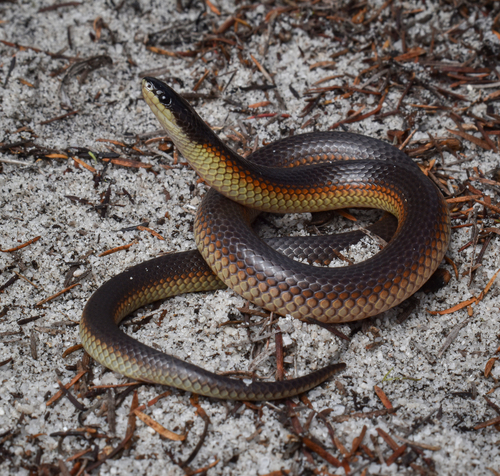
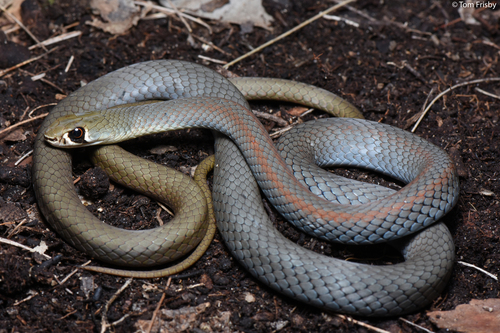
Demansia psammophis, commonly called the yellow-faced whip snake, is a slender species with a narrow head. It reaches a maximum total length of 1 meter (39 inches), with an average length of around 80 centimeters (31 inches); females are slightly smaller than males. The species can be distinguished from other snakes in the Demansia genus by specific head markings: a narrow yellowish head, a pale ring around the eyes, and a dark curved marking along the upper lip. Juveniles have an additional distinguishing feature: a white-edged dark line across the snout. D. psammophis has large, prominent eyes encircled by a pale ring, and has the largest eyes of any Australian snake. This trait supports its success as a diurnal species by aiding in prey capture. Its body color varies, ranging from olive green to grey and brown, but most individuals have a shared color characteristic: a red flush along the anterior third of the back. Accurate identification of this species requires a clear view of the head and a count of the dorsal scales at the snake's mid-body. D. psammophis has 15 mid-body dorsal scale rows, 165 to 230 ventrals, and divided anal and subcaudal scales. It is often confused with the eastern brown snake (Pseudonaja textilis) due to their similar appearance. D. psammophis is distributed across most of Australia, and is present in every Australian state except Tasmania. Despite its wide range across the continent, it is endemic to Australia. It occupies a wide variety of habitats, from coastal forests to arid scrublands and grasslands in Australia's interior. This snake is a community dweller, so it is not unusual to find multiple individuals together. They commonly share habitats in rock crevices and under logs, and communities often aggregate during the winter months. D. psammophis is oviparous. It lays egg clutches of two size ranges: 5 to 6 eggs, and 15 to 20 eggs. Communal egg laying is common for this species, and some communal nests hold as many as 500 to 600 eggs. For female D. psammophis, vitellogenesis occurs between September and November, and ovulation takes place in late spring or summer. Eggs are laid in February and March. Each newly hatched juvenile has an approximate snout-to-vent length of 17 centimeters (6.7 inches).