About Deltote pygarga (Hufnagel, 1766)
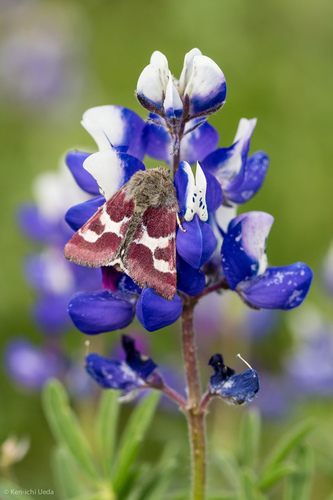
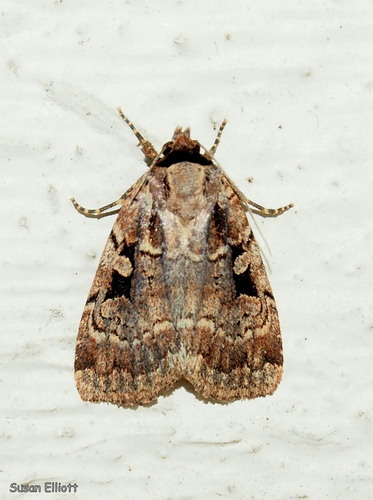
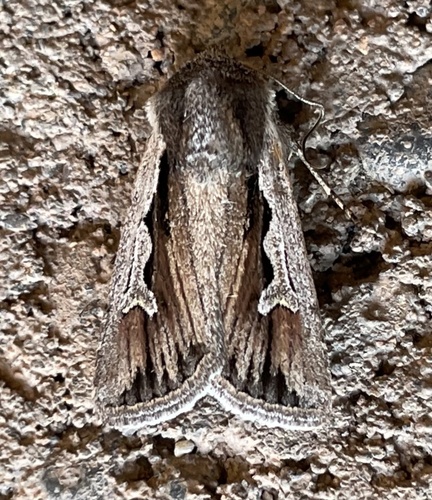
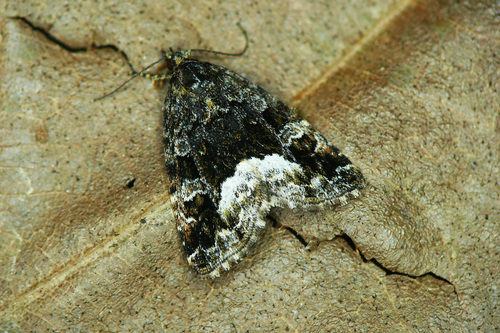
This species, Deltote pygarga (Hufnagel, 1766), has a wingspan of 20–26 mm. Its forewings are white, suffused with fuscous and black. The inner and outer lines are double and blackish. The inner line is filled with grey and obscure, while the outer line is filled with white and strongly excurved beyond the cell. The stigmata are grey, with paler outlines: the orbicular stigma is round, and the reniform stigma is kidney-shaped. They are separated by black scaling, which also follows the outline of the reniform stigma. The claviform stigma is grey brown, edged with white at its end, and followed by black scaling. The submarginal line is pale, preceded by dark shading that thins out toward the inner margin. The space beyond the outer line in the lower half of the wing is more or less white. The hindwing is fuscous, with a whitish fringe. Several named forms differ in wing pattern and color. In the form albilinea Haw., the dark shading before the submarginal line is strongly developed all the way to the inner margin, reducing the white space beyond the outer line to a narrow line running from the costa to the inner margin. In albomarginata Spul., the dark shading is underdeveloped, so the white area extends to the costa as a broad band. In gueneei Fallou, a form found in south-west France, the entire wing is suffused with rufous, also described as nut brown by Fallou. This species is distributed across all of Europe, including Scandinavia. To the east, its range extends through Asia Minor, northern Iran, Afghanistan, southern Siberia, Central Asia, and China, reaching as far as Sakhalin, Korea, Japan, and Taiwan. To the south, it occurs in all countries bordering the Mediterranean, including several Mediterranean islands. In the Alps, it can be found at elevations up to 1000 m.