About Deltarhynchus flammulatus (Lawrence, 1875)
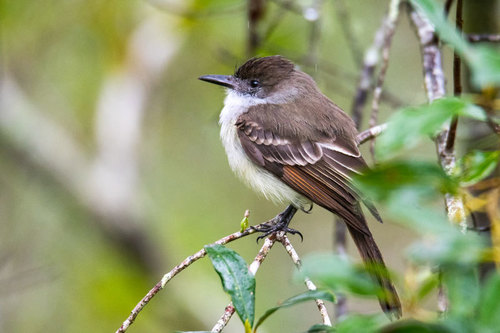
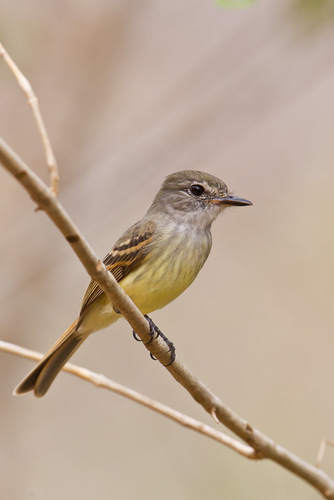
The flammulated flycatcher, scientifically named Deltarhynchus flammulatus (Lawrence, 1875), measures approximately 15 to 17 centimeters (6 to 6.5 inches) in total length and has a chunky body shape. Adult males and females have similar plumage: both have olive to faded gray-brown upperparts and head, a whitish supraloral stripe and a whitish crescent behind the eye, and a dusky lore. The throat is whitish, the chest is pale gray with faint, hard-to-spot dusky streaking, and the belly and undertail coverts are pale yellow. This species has dark brown, well-rounded wings, with coverts and remiges edged in pale cinnamon; wings are around 7.6 centimeters (3 inches) long. The tail is also dark brown, edged with a narrow band of pale cinnamon. It is slightly shorter than the wing and has a gently rounded shape. The bird's bill is black, broad, and triangular, with a slightly paler base, and is roughly half the length of its head. Legs are dark gray, ending in large, curved, sharp claws. The inside of the mouth is orange, and the iris is brown. Juvenile plumage is similar to that of adults, but the juvenile tail has a broad pale cinnamon band. This flycatcher is endemic to the Pacific lowlands of western Mexico, along the coast from Sinaloa to western Chiapas; it may extend into Guatemala, but this occurrence has not been confirmed. Its total estimated range covers 66,000 km² (25,482.7 sq mi). The species' range is discontinuous, and it occurs at low densities where it is present. It inhabits dry deciduous forest, arid and semi-arid thorn forest, and scrubby woodland at elevations between 1,000 and 1,400 meters (3,300 to 4,600 feet) above sea level, and it does not migrate. The flammulated flycatcher is a sluggish, skulking species that typically stays within underbrush. When excited by an intruder, or when courting a mate, it raises the feathers on its crown to form what looks like a crest; unlike closely related flycatchers of the genus Myiarchus, it does not bob its head while displaying this crest. This species breeds around June each year. It builds cup-shaped nests in shallow tree cavities that are unusually close to the ground, at roughly 90 centimeters (35 inches) above ground level. Nests are constructed from fine vegetable fibers, dried leaves, and shredded bark. Unlike similar Myiarchus flycatchers, it does not use snakeskin or other similar materials in its nest. The female lays three eggs, which are creamy to pinkish with brown and gray splotches.