About Delta dimidiatipenne (de Saussure, 1852)
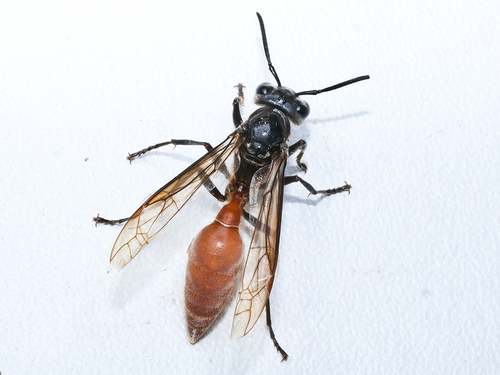
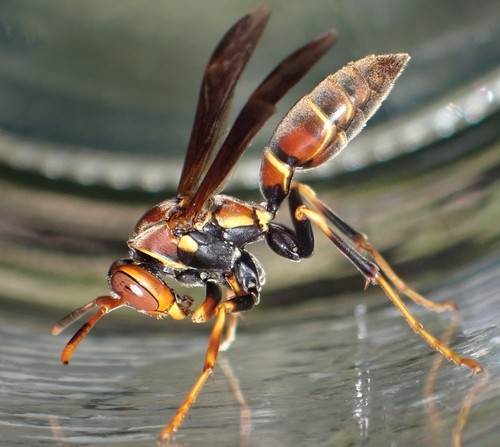
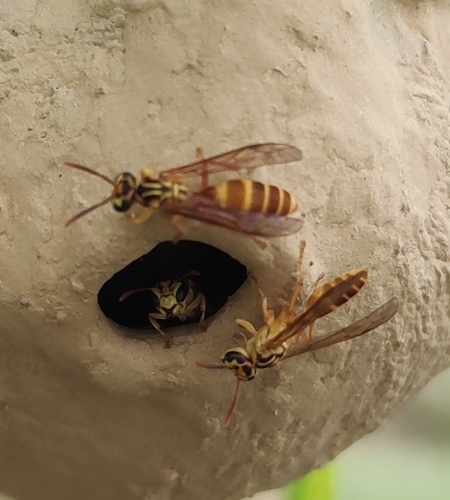
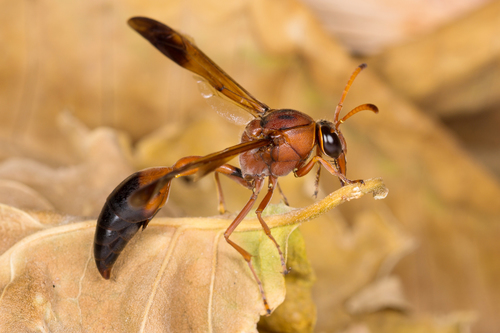
Delta dimidiatipenne, a species of solitary wasp, can be identified by its specific physical features. It has a dull reddish head marked with black; these black markings stretch from behind the eyes, across the top of the head, to the back of the neck. Its thorax is mostly black, with the exception of red patches on the second segment, as well as on the upper sections of the third and last segments. Like other solitary wasps of this type, it has a narrow waist formed by the fusion of the thorax and the first abdominal segment. Most of its abdomen is black, with only one red band located just beyond the narrow waist. Its wings are rust-colored with grey-brown tips, and they may sometimes carry a faint purplish tinge. The tips of its antennae are typically black. Males and females look very similar overall, but males are slightly smaller and more slender, and have a distinct yellow blotch on the face. Females have a total body length of 20 to 23 millimeters, while males measure slightly shorter, at 19 to 22 millimeters. This species is widespread across its native range: it occurs from Morocco across North Africa to Egypt and Somalia, covers the entire Middle East, and extends east as far as India and Nepal. It was intentionally introduced to the Canary Islands in 1988, and is now widespread across the archipelago. Delta dimidiatipenne is generally considered a desert species, but it can also be found in gardens in eastern Arabia.