About Delphinapterus leucas (Pallas, 1776)
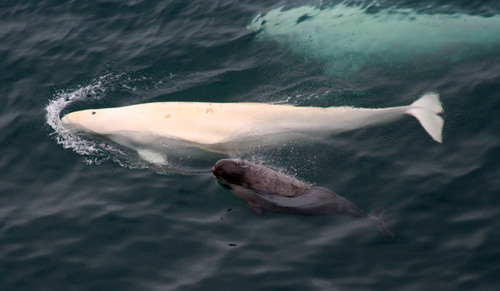
Belugas, scientifically named Delphinapterus leucas (Pallas, 1776), have a round, muscular body tapered at both ends. Tapering starts at the base of the neck, which gives belugas the appearance of having shoulders, a trait unique among cetaceans. Unlike other cetaceans, beluga whales do not have fused neck vertebrae, and their neck is narrower than that of other living whales. This unusual vertebra structure allows belugas to move and nod their heads. Belugas have a discontinuous circumpolar distribution across Arctic and sub-Arctic waters. In summer, they are mostly found in deep waters between 76°N and 80°N, particularly along the coasts of Alaska, northern Canada, western Greenland and northern Russia. The southern edge of their range includes isolated populations in the St. Lawrence River (Atlantic), as well as the Amur River delta, Shantar Islands, and the waters surrounding Sakhalin Island in the Sea of Okhotsk. Belugas use a wide variety of habitats. They are most commonly spotted in shallow waters near the coast, but have also been recorded living for extended periods in deeper water, where they feed and give birth to their young. In coastal areas, they can be found in coves, fjords, canals, bays, and shallow Arctic Ocean waters that receive constant sunlight. In summer, they are also often seen in river estuaries, where they feed, socialize, and give birth to young; these waters typically have a temperature between 8 and 10 °C. The mudflats of Cook Inlet in Alaska are a popular spot for belugas to spend the first few months of summer. In the eastern Beaufort Sea, female belugas with their young and immature males prefer open waters close to land, while adult males live in ice-covered waters near the Canadian Arctic Archipelago. Younger males and females with slightly older young are found closer to the ice shelf. In general, the use of different summer habitats reflects differences in feeding habits, predator risk, and reproductive factors between beluga subpopulations. Estimates of the age of sexual maturity for beluga whales vary widely. Most authors estimate that males reach sexual maturity between nine and fifteen years old, and females between eight and fourteen years old. Other sources note that males take seven to nine years to reach sexual maturity, while females take four to seven years, meaning there is a slight difference in sexual maturation time between males and females. The average age for first birth in females is 8.5 years; fertility starts to decrease at 25 years old, and females eventually undergo menopause, losing reproductive capacity. No births have been recorded in females older than 41. Female belugas typically give birth to one calf every three years. Most mating occurs between February and May, though some mating takes place at other times of year. Belugas may experience delayed implantation. Gestation has been estimated to last 12.0 to 14.5 months, but data from captive females suggests it can last up to 475 days, or 15.8 months. During the mating season, the weight of beluga testes doubles, and testosterone levels increase; this increase appears to be independent of copulation. Copulation typically occurs between 3 and 4 AM. Calves are born over an extended period that varies by location. In the Canadian Arctic, calves are born between March and September; in Hudson Bay, peak calving is in late June, and in Cumberland Sound most calves are born from late July to early August. Births usually happen in bays or estuaries where the water temperature is between 10 and 15 °C. Newborn belugas are about 1.5 m (4 ft 11 in) long, weigh around 80 kg (180 lb), and are grey in colour. They are able to swim alongside their mothers immediately after birth. Newborn calves nurse underwater and start lactation a few hours after birth, and feed roughly every hour after that. Studies of captive females show that beluga milk composition varies between individuals and by lactation stage. On average, beluga milk contains 28% fat, 11% protein, 60.3% water, and less than 1% residual solids, with about 92 calories per ounce. Calves remain dependent on their mothers for nursing for the first year, when their teeth emerge. After their teeth come in, calves start supplementing their diet with shrimp and small fish. Most calves continue nursing until they are 20 months old, though lactation can occasionally continue for more than two years, and lactational anoestrus may not occur. Alloparenting, meaning care from a female that is not the calf's mother, has been observed in captive belugas, including spontaneous long-term milk production. This suggests this behaviour, which is also seen in other mammals, may also occur in wild belugas. Hybrids between belugas and narwhals have been documented; specifically, these hybrids come from a beluga father and a narwhal mother. One, and possibly as many as three, of these hybrids were killed and harvested during a sustenance hunt. It remains unknown whether these hybrids are able to reproduce. The unusual teeth of the single remaining hybrid skull indicate that the hybrid hunted on the seabed, much like walruses, meaning its feeding habits differed from both parent species.

