About Delma tincta De Vis, 1888
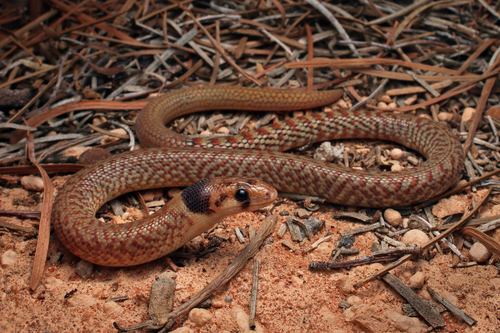
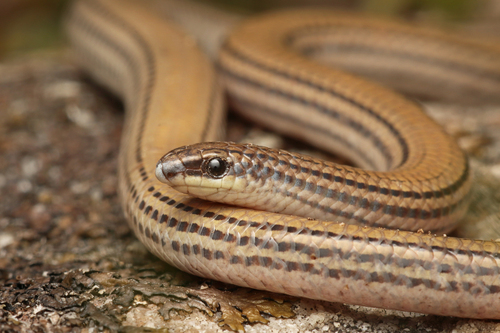
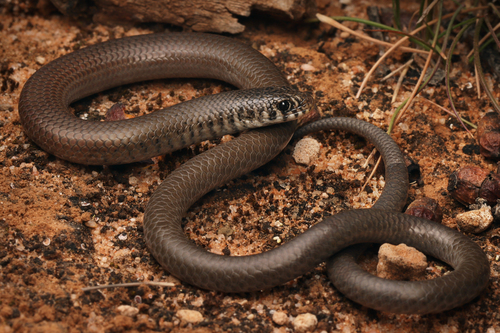
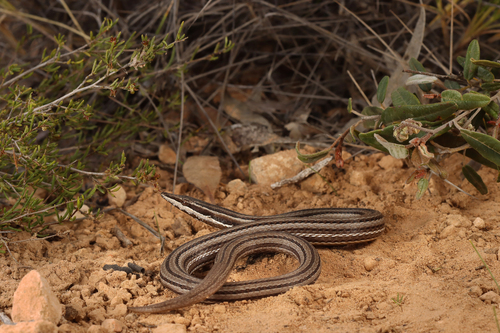
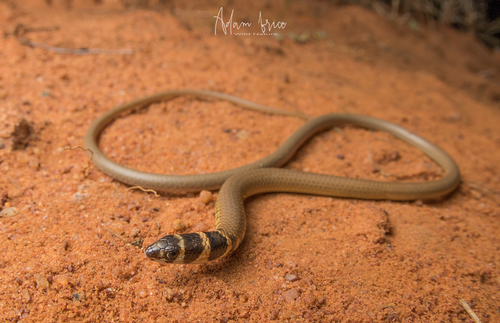
The excitable delma (Delma tincta) strongly resembles a snake, as it has completely lost its limbs over the course of evolution. It has an extremely long, slender body, with a tail that is three to four times the length of its body, and a rounded snout. In adult excitable delmas, the snout-to-vent body length is approximately 80 to 90 mm, and the average tail length reaches 240 mm. Juveniles typically measure 40 mm from snout to vent, with a 136 mm tail. Relative to other species in the Delma genus, excitable delmas are small to moderately sized. Their dorsal body ranges in color from olive green to grey-brown, and their underbelly is white-cream. They have 14 rows of midbody scales, three subocular supralabial scales, and one pair of supranasal scales. Three distinct black markings run across the upper head and neck, intersected by four yellow bands: the first on the muzzle, the second before the eye, the third behind the eye, and the last across the rear of the head. These head and neck markings are more prominent in juveniles. The excitable delma gets its common name from being the most active species among pygopodids. It has a unique jumping defense mechanism: it twists its body in acrobatic movements to scare or confuse predators. When agitated, it uses its long tail to create an upward thrust that lifts its entire body off the ground, and it changes direction erratically with each jump. Researchers at the University of California, Berkeley observed an adult excitable delma in captivity that jumped more than 30 times without any external stimulus. The jumps reached heights of 11 to 15 cm and took 0.41 to 0.45 seconds from initial lift to impact. The excitable delma moves through its habitats using a locomotor pattern called saltation. Among limbless vertebrates, saltation is common, and in the pygopodid family, it acts as a behavioral response to predation. While it is sometimes mistaken for an escape response, that is not its function. Saltation here consists of side-pushing locomotion, and jumping allows the delma to move its body at a greater wave speed. The movement starts in the tail, and the lizard has evolved to propel itself forward at a 45° angle. Like other pygopodid lizards, the excitable delma can also vocalize as an additional defense mechanism.