About Delichon urbicum (Linnaeus, 1758)
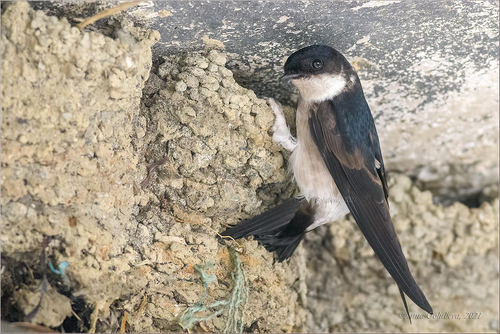
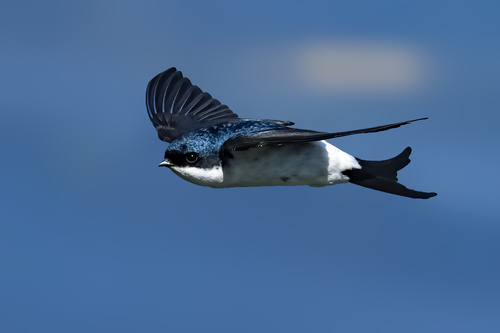
Adult western house martins (Delichon urbicum) are 13 cm (5 in) long, with a 26–29 cm (10–11+1⁄2 in) wingspan and an average weight of 18.3 g (21⁄32 oz). Their upperparts are steel-blue, with a white rump; all underparts, including underwings, are white. Even their short legs have white downy feathering. They have brown eyes, a small black bill, and pink toes and exposed leg areas. The two sexes are similar in appearance. Juvenile western house martins are sooty black, with white tips and edging on some of their wing coverts and flight feathers. The subspecies D. u. lagopodum differs from the nominate D. u. urbicum: its white rump extends much further onto the tail, and its tail fork depth is intermediate between the nominate race and the Asian house martin. The western house martin's clearly visible white rump and white underparts in flight stop it from being confused with other common Palaeoarctic swallows, including the barn swallow (Hirundo rustica), sand martin (Riparia riparia), and red-rumped swallow (Cecropis daurica). In Africa, it could potentially be confused with the grey-rumped swallow (Pseudhirundo griseopyga), but that species has a grey rump, off-white underparts, and a long, deeply forked tail. The western house martin has an average wing beat rate of 5.3 beats per second, which is faster than the barn swallow's 4.4 beats per second. Its flight speed of 11 m/s (36 ft/s) is typical for swallows and martins (hirundines). This is a noisy species, especially at breeding colonies. Males sing a soft twitter of melodious chirps year-round. Its contact call, used even on wintering grounds, is a hard chirrrp, and its alarm call is a shrill tseep. The western house martin breeds across temperate Eurosiberia east to central Mongolia and the Yenisei River, and also in Morocco, Tunisia, and northern Algeria. It is a long-distance broad-front migrant, wintering in sub-Saharan Africa. Its preferred breeding habitat is open country with low vegetation such as pasture, meadows, and farmland, preferably located near water. It also occurs in mountains up to at least 2,200 m (7,200 ft) elevation. It is far more adapted to urban areas than the barn swallow, and will nest even in city centres if air quality is clean enough. It is more often found near trees than other Eurasian swallows, since trees provide both insect food and roosting sites. This species does not normally use the reed-bed roosts preferred by migrating barn swallows. It uses similar open habitats on its wintering grounds, but it is less conspicuous than wintering barn swallows, tends to fly higher, and is more nomadic. In tropical parts of its wintering range such as East Africa, it is mainly found at higher elevations. As a broad-front migrant, European western house martins do not concentrate through the short sea crossings used by large soaring birds, instead crossing the Mediterranean and Sahara directly. Migrating birds feed on insects in flight and usually travel during daylight hours. Migration carries significant hazards: in 1974, several hundred thousand western house martins were found dead or dying in the Swiss Alps and surrounding areas after being caught in heavy snowfall and low temperatures. Adult survival during autumn migration depends mainly on temperature, with precipitation as another major factor; for juveniles, low temperatures during the breeding season are a more critical influence. Because climate change is predicted to make extreme weather more frequent, future survival rates are expected to be more affected by adverse weather conditions than they are currently. Western house martins return to their breeding grounds a few days after the first barn swallows arrive. Like barn swallows, they rarely go directly to nesting sites when weather is poor, instead hunting for food over large fresh water bodies. There are recorded cases of migrant western house martins staying to breed in Namibia and South Africa rather than returning north. As expected for a long-distance migrant, it has occurred as a vagrant east to Alaska, west to Newfoundland, Bermuda, and the Azores, with one additional record of a western house martin in Colombia.