About Delichon dasypus (Bonaparte, 1850)
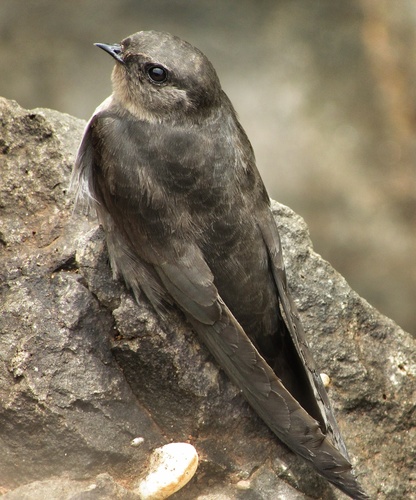
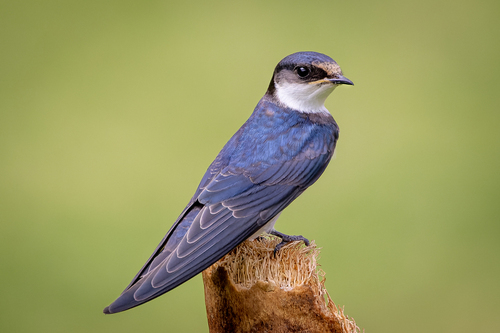
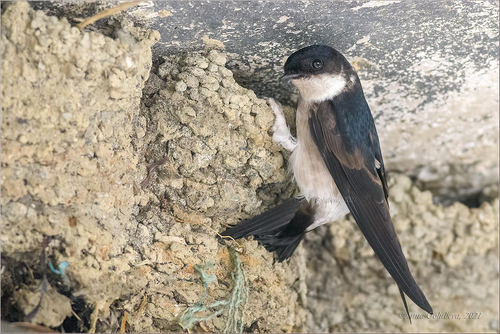
Delichon dasypus, commonly known as the Asian house martin, was first formally described by Bonaparte in 1850. For the nominate subspecies, adult Asian house martins measure 12 cm (4.7 in) in total length. Their upperparts are colored dark steel blue, with a distinctly contrasting white rump. Underparts are white with a light grey wash, and the tail is slightly forked. The tail and upperwings are brownish-black, while the underwings are grey-brown. Legs and feet are brownish-pink, covered in white feathers; the eyes are brown, and the bill is black. There are minimal overall appearance differences between males and females, though males have slightly whiter underparts than females, particularly when their plumage is fresh. Juvenile birds are less glossy than adults, have dark brown upperparts, sometimes with a light brown wash on the rump, and grey-white underparts. The subspecies D. d. cashmiriensis has brighter blue upperparts and a whiter rump than the slightly larger nominate subspecies. The third and smallest subspecies is D. d. nigrimentalis. All three subspecies can be distinguished from the visually similar Nepal house martin by the Nepal house martin’s black chin, black undertail coverts, and much squarer tail shape. The Asian house martin is more similar in appearance to the common house martin, but has darker underparts and a tail that is less deeply forked. The highest risk of misidentification is between adult male Asian house martins, which have paler underparts, and the eastern subspecies of common house martin, D. urbicum lagopodum. While D. u. lagopodum has a less forked tail than western common house martin subspecies, it still has a more pronounced fork than the Asian house martin. The song of this species is a rippling metallic trill or sibilant twitter, and its call is a dry metallic cheep, most often made with two or three syllables. This vocalization is similar to that of the common house martin, but has a more rasping quality. The nominate subspecies D. d. dasypus breeds in southeastern Russia, the Kuril Islands, Japan, and sometimes Korea. It migrates through eastern China to winter in the Malay Peninsula, Borneo, the Philippines, Java, and Sumatra; a small number of individuals remain year-round around hot springs in Japan. D. d. cashmeriensis breeds across the Himalayas, ranging from Afghanistan east to Sikkim, and north into Tibet, and western and central China. It occurs at altitudes between 1,500–5,000 m (4,900–16,400 ft), and is most commonly found between 2,400–4,000 m (7,900–13,100 ft). This subspecies is a short-range migrant, mostly wintering at lower altitudes in the Himalayan foothills. Some individuals winter on the plains of northeastern India, and in northeastern and southeastern Bangladesh, with smaller numbers traveling further to Myanmar and northern Thailand. The third subspecies, D. d. nigrimentalis, breeds in southeastern China and southern Siberia. Its full wintering grounds are not currently known, but members of this subspecies in Taiwan only move to lower altitudes for the winter. Non-breeding Asian house martins have been recorded as far west as the United Arab Emirates. The range of D. d. cashmeriensis overlaps with the range of the Nepal house martin, though the two species breed at somewhat different altitudes. This altitude separation, combined with small differences in appearance, is enough to prevent interbreeding between the two species. The preferred breeding habitat of the Asian house martin is valleys and gorges in mountainous areas, or coastal cliffs, where natural caves or crevices provide natural nest sites. The species will also breed on large man-made structures such as temples, hotels, or power stations. In winter, Asian house martins generally move to lower altitude open or hilly country, though they have been recorded at altitudes as high as 2,565 m (8,415 ft) in Thailand.