About Delias hyparete (Linnaeus, 1758)
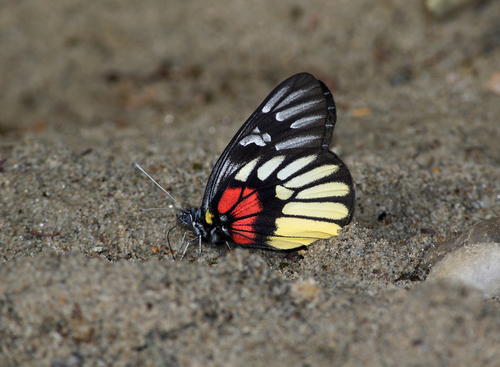
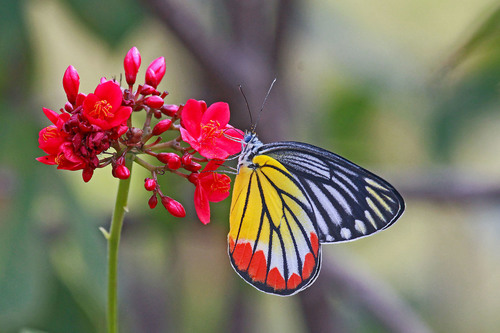
Delias hyparete closely resembles Delias eucharis, but can be distinguished by the following features. For males, the upper side of the forewing has more diffuse black margins along the veins; the transverse postdiscal band is diffuse, ill-defined, and oblique. Its lower portion is not parallel to the wing's termen, and terminates at the apex of vein 2. The apical section of the wing beyond the fascia is more or less heavily shaded with black scales, which makes the white lance-shaped spaces between the veins that are prominent in D. eucharis ill-defined and obscure. The hindwing is white, and the black venation, narrow terminal black border, and subterminal vermilion-red spots between the veins on the underside show through via transparency. On the underside, the forewing matches that of D. eucharis, but the black margins along the veins are much broader, and the postdiscal transverse fascia is oblique like that on the upperside but broader. The hindwing differs from that of D. eucharis by its much deeper chrome-yellow ground colour. The curved postdiscal black band that separates the yellow ground colour from the subterminal vermilion-red spots in D. eucharis is entirely absent. The red spots themselves are pointed inwardly rather than subcordate, and they noticeably increase in size towards the posterior. Antennae, head, thorax, and abdomen are similar to those of D. eucharis. The female of D. hyparete differs from the female of D. eucharis on the upperside by much darker shading, especially on the forewing, and by having a postdiscal transverse band that is oblique like in D. eucharis but broader. The hindwing is also more darkly shaded, and the curved postdiscal transverse black band is completely absent. The underside matches that of the female D. eucharis but is darker, with the forewing in particular more heavily shaded with black scaling, and preapical interspaces tinged with yellow. Antennae, thorax, and abdomen are similar to those of D. eucharis. Subspecies D. h. metarete Butler, which occurs in Southern Myanmar and extends to Java and Sumatra, differs from D. h. hierta as follows. The male upperside has a much purer white ground colour; the apical half of the forewing is densely shaded with black scales, in contrast to the white basal half. On the underside, colours are clearer and purer. The chrome yellow on the hindwing is confined to the base and posterior half of the wing, while the apical half of the cell and the anterior interspaces within the line of the vermilion-red spots are pure white; the anterior two or three subterminal red spots are margined on the interior with diffuse black scaling. The female differs less from the female D. h. hierta, but the yellow colour on the underside of the hindwing is as restricted as it is in the male. The subterminal red spots are a richer vermilion than they are in D. h. hierta, and the anterior two or three have an interior narrow margin of diffuse black scaling, just like in the male. Antennae, head, thorax, and abdomen match those of D. h. hierta, but the thorax and abdomen are shaded slightly darker and have a bluish-grey appearance. Subspecies D. h. ethire Doherty, which occurs in Madras, Orissa, and Lower Bengal, differs from typical D. h. hierta as follows. The male upperside is very pure white. The black margins along the veins of the forewing are very narrow, the oblique postdiscal band is ill-defined, and there is almost no black scale irroration on the apical half of the wing. The hindwing is pure white, and the colours of the underside show through transparency just as in D. h. hierta. On the underside, the main difference from D. h. hierta is the brighter yellow tint on the hindwing, and the more clearly defined, less diffuse black margins of the veins. The female differs less from female D. h. hierta than the male differs from the corresponding sex of D. h. hierta. On the upperside, the interspaces beyond the postdiscal oblique band on the forewing, and the cell and basal halves of the interspaces beyond the cell on the hindwing, are distinctly tinged with yellow. On the underside, all markings are more neatly and clearly defined than in D. h. hierta, and the interspaces beyond the oblique postdiscal band on the forewing are bright lemon-yellow. Antennae, head, thorax, and abdomen of both sexes match those of D. h. hierta. The 2.5 centimeter pupa has a short black ridge on its anterior end, spike-like dorsal processes across most body segments, and spike-like lateral black processes on the early abdominal segments. A few black streaks are present on the wing pad.