About Delairea odorata Lem.
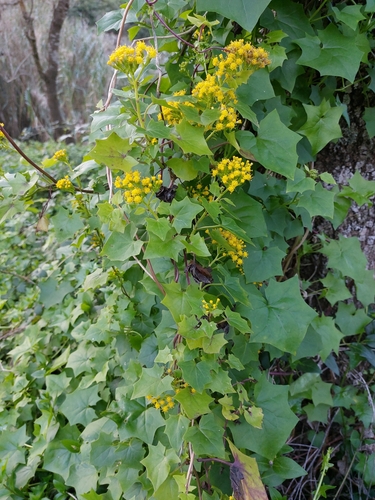
Delairea odorata Lem. is a fast-growing vine that can climb to heights of 2–4 metres (7–13 ft). Its glossy, semi-succulent leaves are alternately arranged along stems, measuring 3–10 centimetres (1+1⁄4–4 in) long and 3–8 centimetres (1+1⁄4–3+1⁄4 in) wide, with 3 to 10 rather broad lobes. The upper surface of the leaves is light green, usually with a subtle purple tinge, while the underside is faintly silvery. Stems and leaves die back between late summer and early autumn, and are replaced by new shoots that use the old stems as climbing support. In its native South Africa, Delairea odorata is relatively uncommon. It was originally recorded in the Drakensberg Mountains, growing on forest edges in moist areas at elevations above 1,500 metres (4,900 ft). Its occurrence in South African coastal areas, including some arid coastal sites, is likely a more recent development. In California, it mostly grows in the coastal fog belt, with a small number of specimens found inland, particularly in subtropical riparian habitats that have permanent moisture. It grows in wetter, temperate regions, and can also grow in cooler subtropical environments, though it is damaged by frost. It prefers partial shade, but can tolerate heavy shade, and can grow well in full sun in cooler, damper areas. Active growth occurs from early autumn to late spring, with a dormant period in summer. Despite being an invasive species, it is grown as an ornamental houseplant valued for its foliage. In cultivation, Delairea odorata (also called German ivy) is grown as a vine or groundcover, and can vigorously climb posts, hedges, trees and shrubs, fences, banks, and walls. It is cultivated in landscaping for its ivy-like leaves and scented flowers, and grows best in bright light or light shade away from intense full sunlight. It is easily propagated by cuttings, because its stems root readily in both water and soil without rooting hormone. Pruning is recommended to encourage bushy, compact growth. While it can tolerate drought, it grows best in moist soil, and cannot survive in waterlogged soil. Overwatering causes leaves to turn brown with curled edges, while underwatering leads to leaf drop. It grows well during moister winter months, especially after rainfall, when it produces bright green foliage. During dry months, it may die back to its stems or grow very little. Common pests affecting the plant are mealybugs and aphids; common diseases include leaf spot and root rot.