About Deinagkistrodon acutus (Günther, 1888)
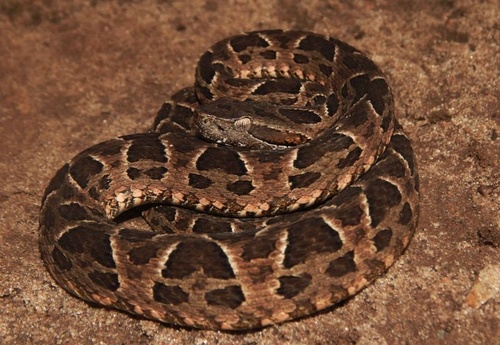
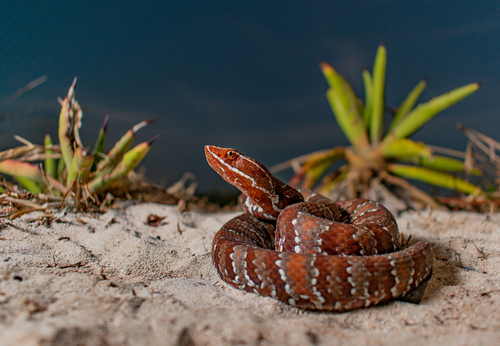
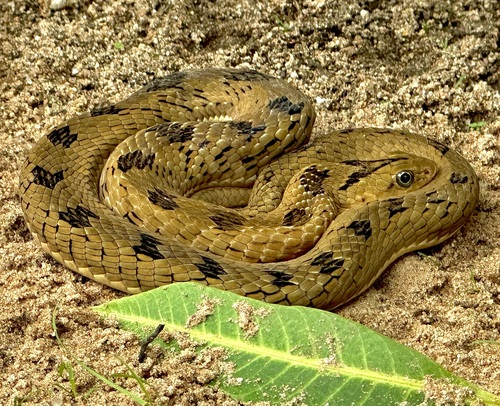
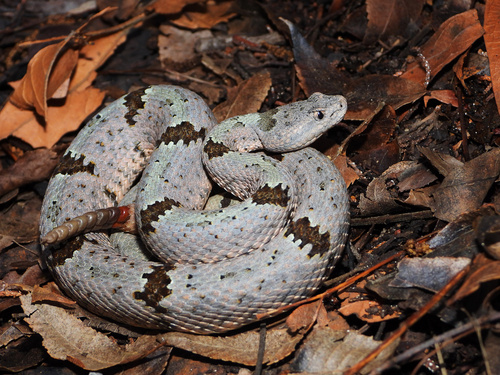
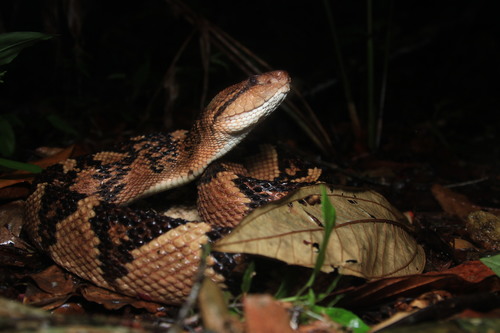
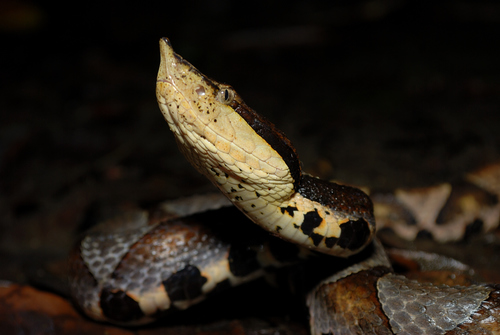
Deinagkistrodon acutus has a light brown or greyish brown dorsal surface, with a row of dark brown lateral triangles along each side. The pointed tops of opposite triangles meet at the midline of the back, forming a series of approximately 20 light brown, squarish blotches. A row of large black spots runs along each side near the belly. The top and upper sides of the head are uniformly black, with a black streak extending from the eye to the corner of the mouth. Ventrally, this species is yellowish with dark brown spots. Juveniles are much lighter in color than adults, but share the same adult pattern. The head is large and triangular, with an upturned snout. The body is very stout, and the tail is short, ending in a compressed, pointed, slightly curved cornified scale. The top of the head is covered by nine large shields. Dorsal scales have strong, tubercular keels. Most subcaudals are paired, with some of the anterior subcaudals being single. This stout species usually reaches a total length (including the tail) between 0.8 and 1.0 meters (2.6 and 3.3 ft). Maximum recorded total length is 1.57 meters (5.2 ft) for males and 1.41 meters (4.6 ft) for females; the largest documented specimen measured approximately 1.549 meters (5.08 ft).
Deinagkistrodon acutus is distributed in southern China (including Zhejiang, Fujian, Hunan, Hubei, Guangdong), Taiwan, and northern Vietnam, and may also be present in Laos. The original species description did not include a type locality. Pratt (1892) and Pope (1935) later assigned the type locality to "Wusueh [Wuxue], Hupeh [Hubei] Province, China", while the British Museum of Natural History catalogue lists it as "Mountains N. of Kiu Kiang [Jiujiang]".
This species inhabits high forested mountains up to 1,350 meters (4,430 ft), and has also been found in low coastal regions as low as 100 meters (330 ft). It prefers lower mountain slopes or rocky hills with small valleys.
Deinagkistrodon acutus is one of the few oviparous pit vipers. Females can lay up to 24 eggs, and may retain eggs during early incubation, an adaptation that shortens incubation time after eggs are deposited. Most clutches contain 11 or 12 eggs, laid between June and August. Eggs measure 40–56 x 20–31 mm (around 2 × 1 inch). Hatchlings are lighter in color and have more vivid patterns than adults, but their color darkens significantly as they age.
The venom of Deinagkistrodon acutus is commonly used for research purposes. Studies have found this venom has protease activity, meaning it attacks and breaks down both intra- and extracellular proteins. When injected into mice, the venom initiates mesangiolysis (degeneration and death of cells that line the inner glomerulus and regulate kidney glomerular filtration) within 2 hours, eventually leading to kidney failure and death. When controlled, the venom has clinical applications; it contains a protein called ACTX-6, which has been shown to induce apoptosis (programmed cell death) in isolated cancer cells by activating the Fas pathway. Fas is a protein that acts as a death receptor in the cell membrane. When activated, Fas triggers a "caspase cascade", a pathway made up of initiator and executioner caspase proteins. Initiator caspases help form an apoptosis initiation factor that eventually activates executioner caspases, which then break down the cell from the inside: they cleave cytoskeleton filaments and DNA until the cell completely breaks apart.
For centuries, Deinagkistrodon acutus venom has been used in traditional Chinese medicine to produce antivenin that effectively treats snakebites. Different parts of the snake are also prescribed to relieve "wind diseases"; because the snakes move very quickly, traditional belief holds that substances from their bodies can easily treat these fast-moving "wind" syndromes. Currently, D. acutus is used to treat patients with arthritis, leprosy, tetanus, boils, and tumors. The traditional reasoning holds that traits that make snakes flexible, able to regenerate skin, and capable of causing paralysis can be transferred to treat human conditions when used medicinally. Preparations include cooking the flesh of the headless body, grinding snake ash into a paste mixed with honey, drying the snake and compressing it into powder, or even injecting venom intravenously. While these practices are common in Chinese medicine, no existing studies have confirmed the effectiveness of these treatments. It remains unknown whether these treatments work via a placebo effect or actually improve patient health.