About Deilephila elpenor Linnaeus, 1758
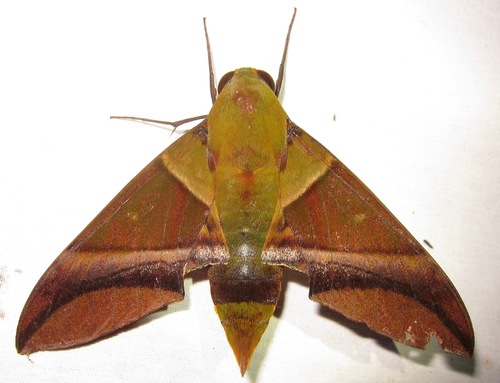
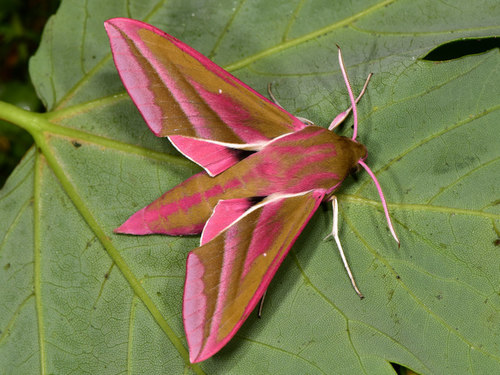
Deilephila elpenor is a moth species first described by Linnaeus in 1758. This moth has olive-brown forewings outlined in pink, with two pink lines running across the wings. The first line is typically thicker, ending near a white dot in the center of the wing. The second line runs below the first, starting from the white inner margins and extending all the way to the wing tip. Its hindwings have a black inner half that gradually transitions to pink from the middle outward, and are edged with white fringes. The moth's head, thorax, and body are also olive-brown, with pink markings across all these areas. D. elpenor is very common in central Europe, and its full distribution covers the entire Palearctic region. It is especially widely distributed across England, Wales, and Ireland. Until the 1980s, the species was only found in the southern half of Scotland, but it has since spread north to the north coast and into mainland Scotland. In general, the species' population becomes sparser and less concentrated in the northern parts of Europe. Its range also extends across Asia, reaching as far as Japan. D. elpenor lives in a wide variety of habitats, including rough grassland, heathland, sand dunes, hedgerows, woodland, open countryside, and even urban gardens. These moths play an important role in pollination within their habitats. For context, studies of hawk moths show they can pollinate between 5 and 10 percent of the tree and shrub species in the areas they inhabit. Most years, D. elpenor produces only a single generation. Occasionally, a small number of individuals from a second generation are recorded in late summer, but this is very rare. The pupae overwinter inside cocoons, and adult moths are active from May to early August. The species' peak activity falls between the midsummer months of June and September.