About Decodon verticillatus (L.) Elliott
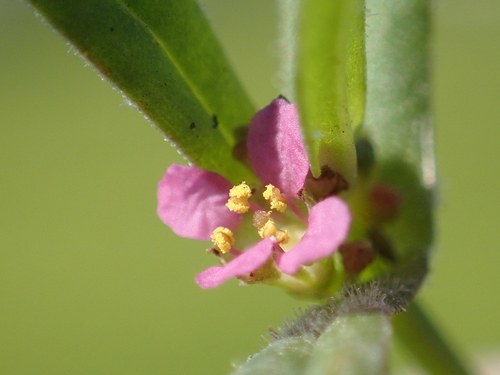
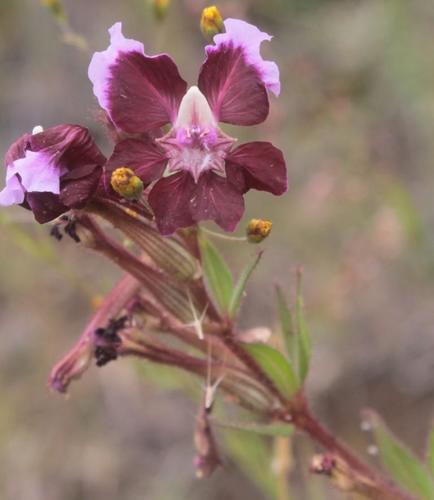
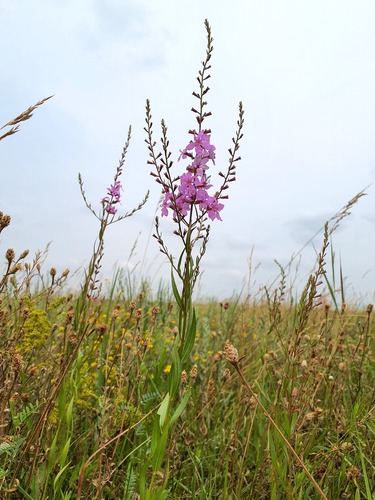
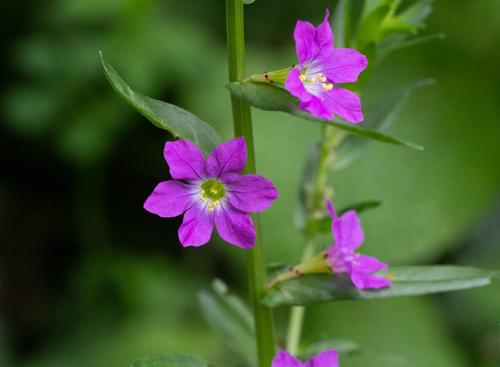
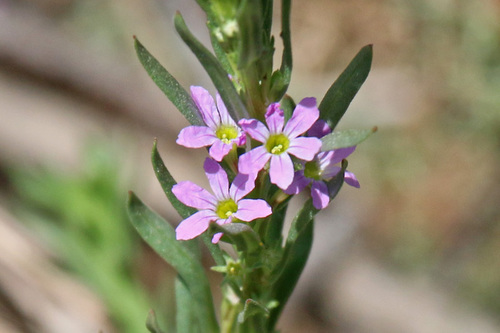
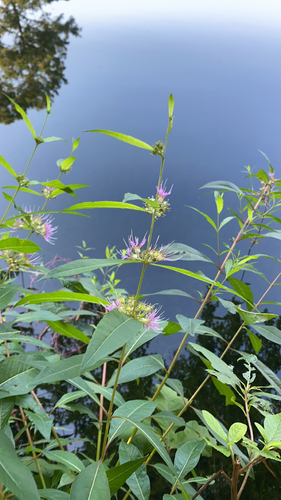
Decodon verticillatus, commonly called waterwillow, is a clump-forming shrubby perennial that grows in swamps or shallow water. Its stems are arching, angular, smooth, and woody near the base, reaching up to 2.4 m (8 feet) tall. When stems bend over to touch the mud, they sometimes root at the tip. The leaves are lanceolate, arranged either in opposite pairs or whorls of three or four. They grow up to 130 mm (5 inches) long and 25 mm (1 inch) wide, are smooth on the upper surface and hairy on the underside, and attach to stems via very short stalks. Rose-pink flowers grow in axillary clusters. The calyx is cup-shaped, and the corolla is less than 25 mm (1 inch) wide, usually with five petals that narrow toward the base. Ten projecting stamens grow on each flower, five of which are longer than the other five. Each flower has one pistil, one style, and a superior ovary. The fruit is a spherical dark brown capsule that holds numerous reddish seeds. Waterwillow flowers in June and July. It can be found in swampland, ditches, alongside streams, and in shallow water along the edges of ponds and lakes. It often forms thickets, and its range extends from Maine to Florida, west to Minnesota, Tennessee, and Louisiana in the United States, as well as eastern Canada.