About Daviesia decurrens Meisn.
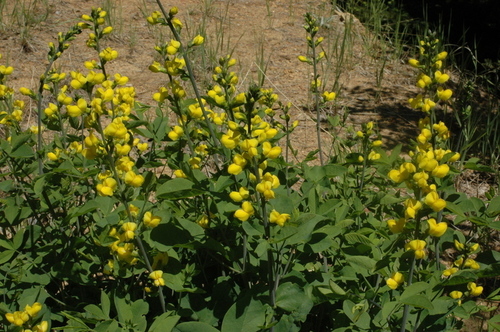
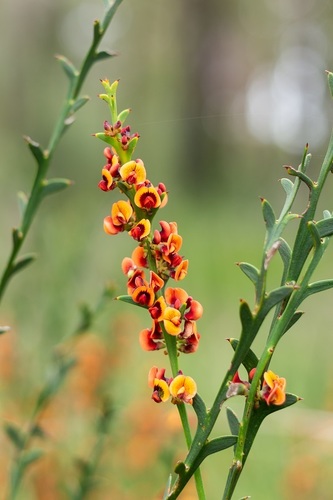
Daviesia decurrens Meisn., commonly known as prickly bitter-pea, is a glabrous shrub with a spreading, erect, or low-lying growth habit. It typically reaches 0.3–1.8 m (1 ft 0 in – 5 ft 11 in) in height and 0.5–1.5 m (1 ft 8 in – 4 ft 11 in) in width. Its true leaves are reduced to scattered, sharply-pointed, triangular to tapering, decurrent phyllodes that are 2–45 mm (0.079–1.772 in) long and 1–12 mm (0.039–0.472 in) wide at the base. Its flowers are arranged in groups of three to seven in leaf axils, growing from a peduncle 0.5–1.5 mm (0.020–0.059 in) long, with a rachis that reaches up to 2.5 mm (0.098 in). Each individual flower sits on a pedicel 0.5–2 mm (0.020–0.079 in) long, with bracts approximately 2.5 mm (0.098 in) long. The sepals are 2.0–2.5 mm (0.079–0.098 in) long and joined at their base; the two upper sepals lobes are very small, while the three lower lobes measure 0.5–1.0 mm (0.020–0.039 in) long. The standard petal is elliptic or egg-shaped, 5–6 mm (0.20–0.24 in) long and 6–7 mm (0.24–0.28 in) wide, and is yellowish pink with a velvety red base. The petals that form the wings are 4.5–7.0 mm (0.18–0.28 in) long and red, and the keel petal is 4.0–4.5 mm (0.16–0.18 in) long and also red. Flowering occurs mainly from May to August, and the fruit is an inflated, broadly triangular pod 8–13 mm (0.31–0.51 in) long. This species is found in Western Australia, ranging from near Dongara to Busselton and eastward to near Albany. Subspecies decurrens mostly grows in eucalypt woodland and forest, and sometimes occurs in swampland. Subspecies hamata grows in heathland, and occurs further inland than subsp. decurrens, with a range from Marchagee to Brookton and inland to near Coolgardie.