About Davidaster rubiginosus (Pourtalès, 1869)
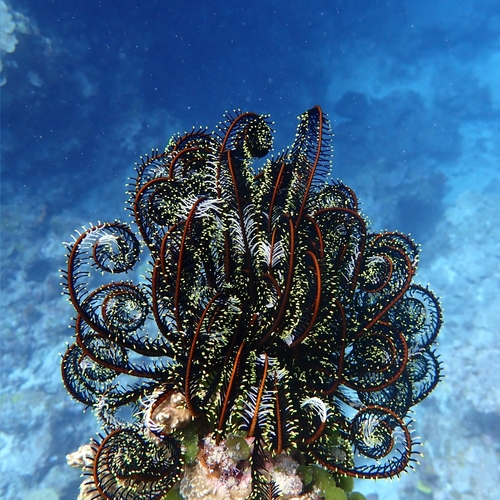
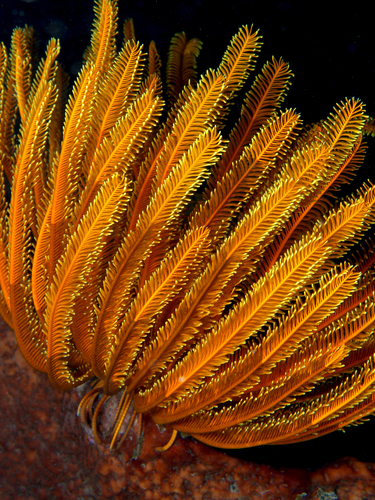
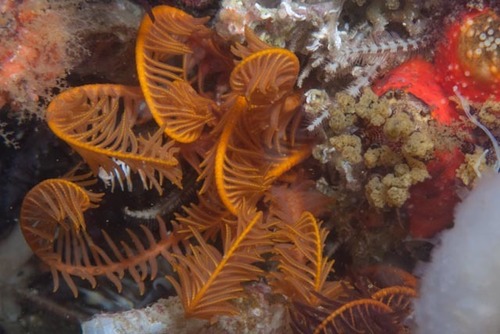
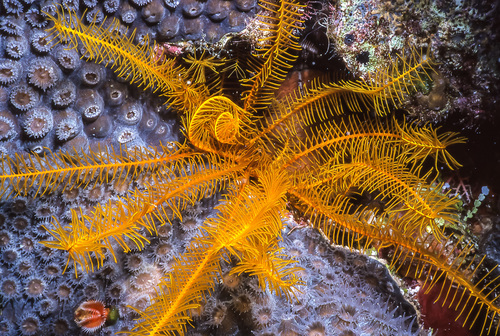
Davidaster rubiginosus, commonly known as the orange sea lily, is a stalkless crinoid. This species has 20 to 35 arms, each measuring 10 to 20 centimetres (3.9 to 7.9 inches) long. The arms radiate from the calyx, a cup-shaped body covered by a lid-like structure called the tegmen. Each arm has a feather-like shape, with many small pinnules projecting alternately from opposite sides. An ambulacral groove runs along the oral surface of each pinnule, and this groove connects continuously to the groove on the main arm. The arms are typically orange with curved, upward-pointing yellow tips, though colour varies; some individuals have white arms with black tips. The ambulacral grooves are black. Both arms and pinnules are made up of a series of jointed plates, with three tube feet present at each joint. The tube feet secrete mucus strands that trap plankton. Cilia move trapped food particles along the grooves to the mouth, which is located at the centre of the tegmen. The orange sea lily inhabits reefs at depths between 10 and 30 metres (33 and 98 feet). Its geographic range extends from Florida, the Caribbean Sea, the Gulf of Mexico, and the Bahamas southward to the coast of Brazil. During the day, the orange sea lily typically hides its body in crevices, under coral, or inside sponges, while extending several of its arms to filter feed. In strong currents or heavy seas, it stops feeding and retracts all of its arms. At night, it leaves its hiding place and may position itself on top of coral or a sea fan with its arms fully extended for feeding. In a study conducted in Jamaica, researchers found that unlike many tropical crinoids, the orange sea lily follows a regular annual breeding cycle. It releases gametes into the water during late autumn and winter. After fertilization, eggs hatch into barrel-shaped vitellaria larvae that have several rings of cilia. These larvae do not feed, and after a few days they settle onto the seabed and undergo metamorphosis into juvenile sea lilies.