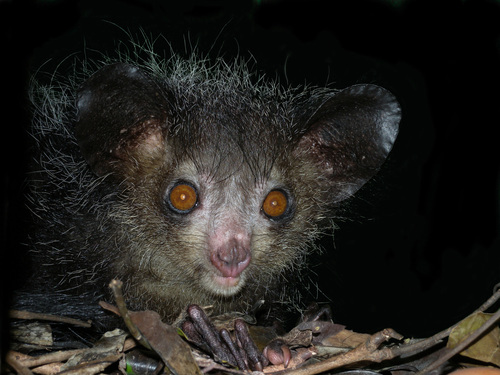
About Daubentonia madagascariensis (Gmelin, 1788)
Anatomy and morphology: A fully grown aye-aye (Daubentonia madagascariensis) is typically around 60 centimetres (2 feet) long from head to body, with a tail that is longer than its body. This species has an average head-and-body length of 36 to 43 cm (14 to 17 in), paired with a tail that measures 56 to 61 cm (22 to 24 in), and weighs approximately 2 kilograms (4 pounds). Young aye-ayes usually have silver-colored fur on their front and a distinct stripe running down their back. As aye-ayes approach maturity, their entire bodies become covered in thick fur, which is typically not a single solid color. The hair ends on the head and back are usually tipped with white, while the rest of the body is ordinarily yellow, brown, or a mix of both colors. One of the aye-aye's most distinctive traits is its specialized fingers. The third finger is much thinner than the other digits; it uses this finger, tipped with a hooked nail, to extract grubs and insects from tree bark. This finger is unique across the animal kingdom: it has a ball-and-socket metacarpophalangeal joint, can reach the throat through a nostril, and is used for picking the nose and eating the mucus collected from inside the nasal cavity (a behavior called mucophagy). The aye-aye has also evolved a sixth accessory digit, called a pseudothumb, that helps it grip objects. The complex ridged geometry on the inner surface of the aye-aye's ears helps sharply focus both echolocation signals produced by its tapping finger, and allows it to passively listen for other sounds made by prey. These ear ridges act as the acoustic equivalent of a Fresnel lens, and similar ridges have been observed in a wide variety of unrelated animals, including the lesser galago, bat-eared fox, and mouse lemur. Female aye-ayes have two nipples positioned in the groin region. Male aye-aye genitalia are similar to those of canids, with a large prostate and a long baculum. Distribution and habitat: Aye-ayes live primarily along the east coast of Madagascar. Their natural habitats are rainforest or dry deciduous forest, but many now live in cultivated areas as a result of deforestation. The most common aye-aye populations are found in rainforests, where they inhabit canopy areas and are usually found at altitudes above 70 meters. They sleep during the day in nests woven from interwoven twigs and dead leaves, built in the tree canopy among vines and branches.

