About Datura wrightii Regel
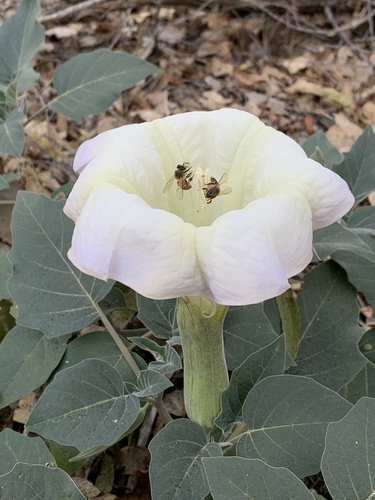
Datura wrightii Regel is a vigorous herbaceous perennial that reaches 30 cm to 1.5 m in both height and width. Its leaves are broad, rounded at the base, and taper to a point, often with wavy margins. The most striking feature of this plant is its flowers: they are sweetly fragrant white trumpets up to 20 cm (7.9 in) long, sometimes tinted purple, especially along the margins. Five narrow points are spaced symmetrically around the flower rim. In very exposed, full-sun environments such as cleared roadsides, D. wrightii often grows as a spreading ground vine close to the ground. This species blooms from April through October. In clear weather, flowers open in the morning and evening and close during the heat of the day, with opening patterns dependent on water availability; in cloudy weather, flowers may open earlier and remain open longer. Seeds develop inside a spiny, globular capsule 3 to 4 cm in diameter, which splits open when fully ripe. In Europe, Datura wrightii has frequently been confused with Datura innoxia, because both are hairy and bear spined hanging fruits. The two species can be distinguished by the hairs on their stems and stalks: D. wrightii has densely appressed hairs, which give stems a near-uniform dull appearance visually and in photographs, while D. innoxia has projecting hairs that make stems dull at the edges and brighter, greener, or shiny along the center where hairs point toward the viewer. D. wrightii also has larger flowers (14-26 cm long) with 5 cusps, and stigmas that sit above the anthers and are often exserted. By comparison, D. innoxia has smaller flowers (12-16 cm long) that often have 10 cusps, and stigmas that sit below the anthers. Datura wrightii is native to northern Mexico and the adjacent southwestern United States, ranging as far north as Eastern Washington. It grows in open, disturbed land and along roadsides with well-drained, sandy soil, and is most naturally abundant in Southern California. It is also commonly planted as an ornamental, particularly in xeriscapes, due to its ruderal characteristics. All parts of Datura plants contain dangerous levels of anticholinergic tropane alkaloids, and may be fatal if ingested by humans, livestock, or pets. In some regions, buying, selling, or cultivating Datura plants is prohibited. Unlike other datura species, the roots are the most potent and most alkaloid-rich part of Datura wrightii. Among the Zuni people, powdered root of this species is used as an anesthetic and narcotic for surgery. A poultice made from root and flower meal is applied to wounds to promote healing. The Zuni also use Datura wrightii to render patients unconscious while setting broken bones.