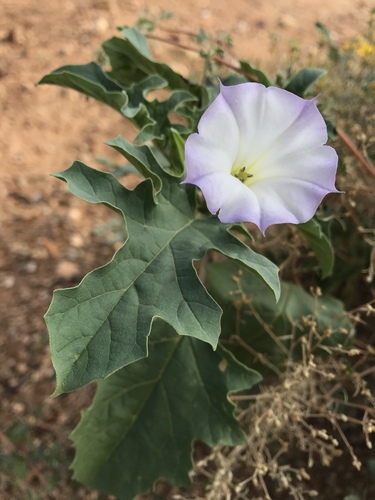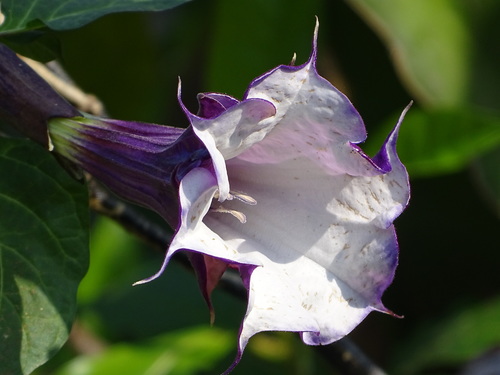
About Datura metel L.
Datura metel L. is an annual or short-lived shrubby perennial herb. It has a branched taproot that is not fleshy, unlike the roots of perennial Datura species such as Datura innoxia and Datura wrightii. This species can grow up to 6 feet (1.8 meters) high. Its stems are hollow, green or purple-black, somewhat woody, and carry a strong odour. The plant is slightly pubescent, with green to dark violet shoots and oval to broadly oval leaves, which are often dark violet as well. The leaves are simple, alternate, petiolate, and have either entire or deeply lobed margins. Its pleasantly-scented flowers measure 6–8 inches (15–20 cm) across, vary greatly in form, and can be single or double. Corolla colour ranges from white to cream, yellow, red, and violet. The seed capsule is covered with numerous conical warts or short, sparse spines. When mature, the fruit breaks apart irregularly, and does not split open into four equal valves like the fruit of other Datura species. Its seeds are endospermous. Datura metel was first formally described by Carl Linnaeus in 1753, but few botanically accurate illustrations were created until after the settlement of the New World. While its origin was long thought to be India, it is now confirmed to be native to the Americas, most likely the Greater Antilles. As recently as 1992, some sources still claimed the plant was "...native probably to the mountainous regions of Pakistan or Afghanistan westward...". There is now no doubt the species originated in the New World, and growing evidence shows it was introduced to the Indian subcontinent no later than the 4th century CE. It is not known whether this introduction happened through human activity or a chance natural event, and this introduction occurred before the first arrival of European explorers in the Americas. No wild form of Datura metel recognized as a distinct species is known to exist. As currently described, the species is essentially a group of ancient cultivars most likely created through pre-Columbian horticultural practices. All parts of Datura plants, including Datura metel, contain dangerous levels of the highly poisonous tropane alkaloids meteloidine, its angelate ester, and datumetine, and can be fatal if ingested by humans or other animals, including livestock and pets. Some places prohibit buying, selling, or cultivating Datura plants. Even tiny quantities of ingested Datura metel may be toxic, with symptoms including flushed skin, headaches, hallucinations, and potentially convulsions or coma. The main toxic components are tropane alkaloids, and ingesting even a single leaf can cause severe side effects. The Thugs, gangs of professional robbers and murderers that traveled the roads of central India, sometimes used preparations of Datura metel to stupefy wealthy merchants they targeted before strangling or stabbing them. The English word thug comes from the Hindi ṭhag, which means "swindler" or "deceiver". Early 19th century colonial accounts of the Thugs tended to reflect an orientalist fantasy of a bloodthirsty, quintessentially Hindu cult that made human sacrifices to the goddess Kali, while modern scholars view Thuggee as primarily criminal activity for profit, carried out by organized groups of disaffected, recently unemployed soldiers of both Hindu and Muslim faith. Occasional reports from early periods note that criminal gangs active long before the rise of Thuggee also poisoned victims with Datura, and Datura was commonly used by many Indian highway robbers to stupefy their targets. It seems the Thugs only used Datura metel intermittently; one Thug referred to this method as a tool for "mere novices", indicating experienced stranglers did not need this aid to commit murder. Datura metel is counted among the 50 fundamental herbs used in traditional Chinese medicine, where it is called yáng jīn huā (洋金花). However, ingesting any form of Datura metel is dangerous and must be treated with extreme caution. Under India's Drug & Cosmetic Act 1940 and Rule 1995, Datura metel is banned in India except for use in Ayurvedic medicine.