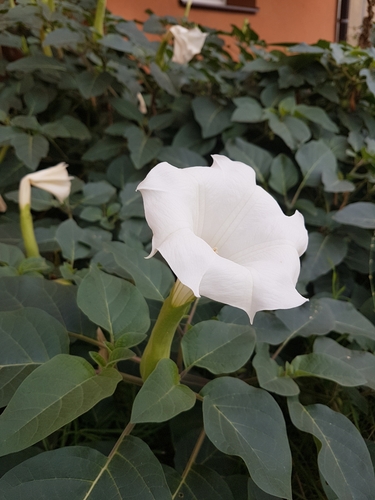
About Datura innoxia Mill.
Datura innoxia Mill. is a tuberous-rooted subshrub that typically grows between 0.6 and 1.5 metres tall. Its stems and leaves are covered with short, soft grayish hairs, which give the entire plant a grayish appearance. It produces elliptic, smooth-edged leaves with pinnate venation. When crushed or bruised, all parts of the plant give off a foul odor similar to rancid peanut butter, though most people find the scent of its flowers quite pleasant when they open at night. The flowers are white and trumpet-shaped, measuring 12 to 19 cm (4.5 to 7.5 in) long. They start growing upright, then bend downward later in development. Flowering occurs from early summer through late fall. The fruit is an egg-shaped spiny capsule, around 5 cm in diameter. Like fruits of other species in section Dutra of the genus Datura, it splits open irregularly when ripe to release its seeds. Seeds may also be dispersed when the spiny fruit gets caught in animal fur, which carries the fruit far from the parent plant. The seeds are long-lived, and can remain dormant in soil for many years. Both the seeds and the entire plant have strong deliriant properties and high overdose potential; effects appear slowly, which often leads users to incorrectly believe their taken dose is ineffective. In Europe, this species is often confused with Datura wrightii; distinctions between the two can be found in information for Datura wrightii. All parts of Datura innoxia are toxic, containing dangerous levels of tropane alkaloids including hyoscyamine and hyoscine. Ingestion may be fatal for humans and other animals, including livestock and pets. Common observed effects of ingestion include enlarged pupils, dry mouth, difficulty breathing, blurred vision, hallucinations, panic, and death. In some regions, buying, selling, or cultivating Datura plants is prohibited. When grown in cultivation, Datura innoxia is usually treated as an annual grown from seed, but its tuberous roots, which are somewhat similar in appearance to the tuberous roots of cultivated Dahlias, can be protected from freezing and replanted the following spring. Like other Datura species, Datura innoxia contains the highly toxic alkaloids atropine, hyoscine (scopolamine), and hyoscyamine. The Aztecs referred to this plant by the Nahuatl names toloatzin and toloaxihuitl, which translates to "the plant with the nodding head" in reference to its nodding seed capsules. Long before the Spanish conquest of Mexico, the Aztecs used the plant for many therapeutic purposes, such as making anodyne poultices for wounds. Even though the Aztecs warned against the risk of madness and "various and vain imaginings", many Native American groups have used the plant as an entheogen to induce hallucinations during rites of passage. The alkaloids of Datura innoxia are very similar to those found in mandrake, deadly nightshade, and henbane, which are also highly poisonous plants that were used cautiously for effective pain relief in antiquity. Datura intoxication typically produces a complete inability to distinguish reality from fantasy, a state of delirium different from typical hallucination; it can also cause hyperthermia, tachycardia, bizarre and potentially violent behavior, and severe mydriasis that leads to painful photophobia lasting for several days. Pronounced amnesia is another commonly reported effect after intoxication. Toxin levels can easily vary by as much as 5:1 from individual plant to individual plant, and a given plant's toxicity depends on its age, growing location, and local weather conditions. These wide variations in toxin content make Datura exceptionally hazardous to use as a drug. In traditional cultures, users needed extensive experience and detailed knowledge of the plant to use it without causing harm, and this knowledge is not widely available in modern cultures. As a result, many negative incidents have followed ingestion of Datura. In the 1990s and 2000s, United States media covered multiple cases of adolescents and young adults dying or becoming seriously ill after intentionally ingesting Datura. Datura innoxia has been planted around the world as an ornamental plant, valued for its attractive large leaves, large white flowers, and distinctive thorny fruit. However, the species is now considered an invasive plant in several locations. For example, because its life cycle matches that of cotton, it grows as a weed in cotton fields. It is also a potential seed contaminant.