About Dasyurus maculatus (Kerr, 1792)
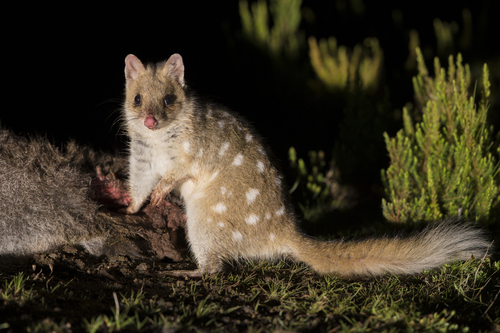
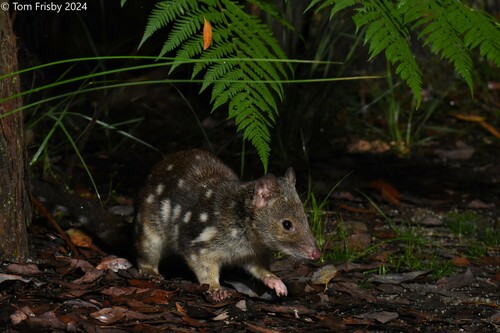
Dasyurus maculatus, commonly called the tiger quoll, is the largest species of quoll. For the northern subspecies (D. m. gracilis), adult females are generally smaller, weighing 1.5 times less than adult males of the same subspecies. On average, male and female D. m. maculatus weigh 3.5 kg (7.7 lb) and 1.8 kg (4.0 lb) respectively, while male and female D. m. gracilis weigh an average of 1.60 kg (3.5 lb) and 1.15 kg (2.5 lb) respectively. The largest recorded male tiger quolls can weigh up to 8.85 kg (19.5 lb), and the largest females can weigh over 4.0 kg (8.8 lb). The tiger quoll has relatively short legs, and its tail is the same length as its body and head combined. It has a thick head and neck, with a slightly rounded, elongated snout. Both the front and hind feet have five toes, and the hind feet have well-developed halluces. Its long pink foot pads are ridged, an adaptation for its arboreal lifestyle that compensates for its non-prehensile tail. Most tiger quolls have a reddish-brown fur coat, while a small minority have black fur; all have white spots, and their coat color does not change with the seasons. It is the only quoll species that has spots on both its body and its tail. The fur and skin are covered in an orange-brown oil. The underbelly is typically greyish or creamy white. Average total length (head to tail tip) for D. m. maculatus is 930 mm (37 in) for males and 811 mm (31.9 in) for females. For D. m. gracilis, males average 801 mm (31.5 in) in total length, and females average 742 mm (29.2 in). For both subspecies, the tail alone averages between 285 and 550 mm (11.2 to 21.7 in) long. Among living mammalian carnivores, the tiger quoll has the second-most powerful bite relative to its body size, able to exert a force of 153 N (34 lbf). The tiger quoll is native to eastern Australia, where it occurs in areas that receive more than 600 mm (24 in) of rainfall per year. Most confirmed sightings of the species are at elevations of at least 600 m (2,000 ft). Historically, the tiger quoll ranged across southeastern Queensland, through eastern New South Wales, Victoria, southeastern South Australia, and Tasmania. European settlement has severely reduced and fragmented the species' distribution on the Australian mainland. Tiger quolls are rare in southeastern Queensland and are mostly restricted to national parks. In Victoria, the species' population has declined by nearly 50%. Range decline has been less severe in New South Wales, but tiger quolls are still rare there. The tiger quoll was probably never very numerous in South Australia; after being considered locally extinct for 130 years, one individual was captured in the state's southeast in 2023. In Tasmania, the tiger quoll is most often found in the northern and western parts of the state, where rainfall follows seasonal patterns. Tiger quolls were once native to Flinders Island and King Island, but have been locally extinct (extirpated) there since the 20th century, so they no longer occur on Tasmania's offshore islands. Tiger quolls can live in a wide variety of habitats, but they prefer humid forests such as rainforests and closed eucalypt forest. They are moderately arboreal, with around 11% of their travel occurring above ground. When in trees, they may hunt arboreal prey such as possums, and will leap between trees when necessary. They usually descend trees head first. Prey consumed by tiger quolls includes insects, crayfish, lizards, snakes, birds, domestic poultry, and smaller mammals such as platypus, rabbits, arboreal possums (including cuscuses and greater gliders), bandicoots, pademelons, small wallabies, and wombats. When hunting, the tiger quoll stalks its prey, stopping only to hold its head up. It then launches an attack, delivering a killing bite to the base of the skull or the top of the neck, depending on the size of the prey. Small prey is pinned down with the forepaws before the bite is delivered. For large prey, the quoll jumps to latch onto the prey's back before biting the neck. Tiger quolls can also climb into trees to hunt for possums and birds at night. They may also scavenge carrion from larger animals such as kangaroos, feral pigs, cattle, and dingoes, though they scavenge less often than Tasmanian devils. In one study, feral rabbits made up 76% of the tiger quoll's diet on the Australian mainland. The flexibility of the species' diet indicates that its prey base is not negatively impacted by bushfires. Tiger quolls themselves may be preyed on by Tasmanian devils and masked owls in Tasmania, and by dingos and domestic dogs on mainland Australia. They may also be hunted by wedge-tailed eagles and large pythons. Tiger quolls will back down from adult Tasmanian devils, but will chase subadult devils away from carcasses. They also likely compete with introduced carnivores including foxes, cats, and feral dogs. Tiger quolls also host many species of endoparasites.