About Dasyurus hallucatus Gould, 1842
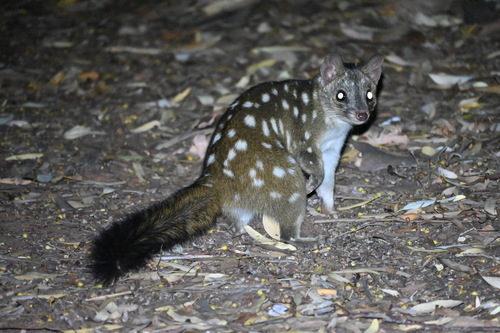
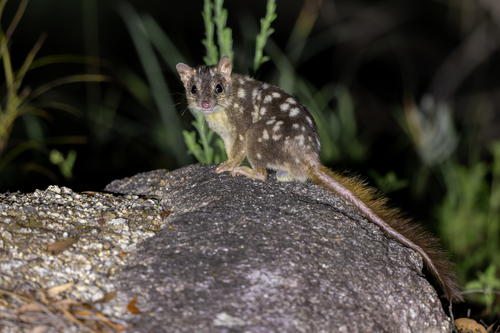
The northern quoll, scientifically named Dasyurus hallucatus, is also commonly called the northern native cat, the North Australian native cat, or the satanellus. It is a carnivorous marsupial that is native to Australia. The current range of the northern quoll extends from the Pilbara region of Western Australia, across the Northern Territory, to southeastern Queensland. Historically, the species had a continuous range that stretched from southeastern Queensland to the Kimberley region of Western Australia; today, its populations are split into several separate, disconnected groups. This quoll species is most abundant in rocky ranges and open eucalypt forest. Analysis of species occurrence records confirms that rocky areas are important habitat for the northern quoll. Northern quoll populations have declined sharply since the European colonisation of Australia. One study conducted in the Northern Territory recorded an approximately 60% contraction in the species' extent of occurrence. Out of nine species analysed in this study, only the brush-tailed rabbit-rat, the sole remaining species in the genus Conilurus, experienced a larger decline. In the Northern Territory, northern quoll populations appear to be persisting and declining more slowly in geographic areas with higher vegetation complexity, lower elevation, and milder temperatures. This pattern suggests that threats to the species may be reduced or better tolerated in these types of areas. More geographically isolated populations, such as those found on islands, contribute very little to the overall genetic diversity of the species. These isolated populations also show relatively high levels of inbreeding compared to northern quoll populations on the Australian mainland.