About Dasyurus geoffroii Gould, 1841
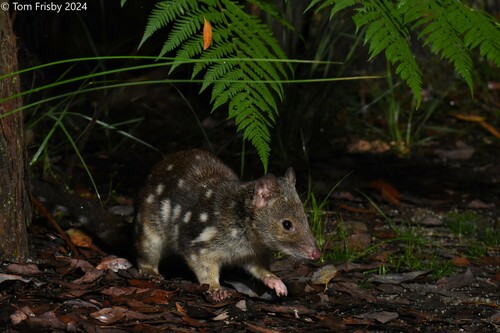
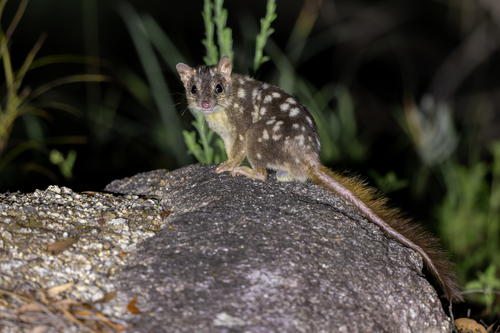
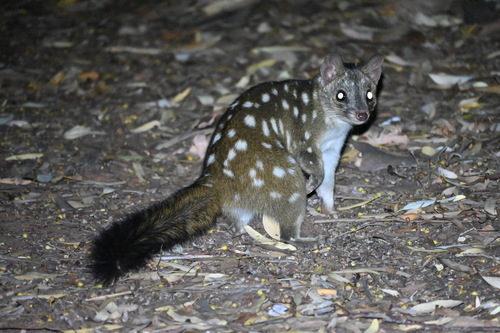
The western quoll, Dasyurus geoffroii, is roughly the size of a domestic cat. It has rufous brown fur, 40–70 white spots across its back, and a creamy white underside. The spots help break up the quoll's outline under moonlight during nighttime hunting. It has five toes on its hind feet and granular pads. Head and body length ranges from 36 to 46 cm (14 to 18 in), and tail length ranges from 22 to 30 cm (8.7 to 11.8 in). With large eyes and pointed ears, the western quoll is well adapted for a nocturnal lifestyle. A black brush covers the tail from its halfway point down to the tip. Males usually weigh around 1.3 kg (2.9 lb), while females typically weigh 0.9 kg (2.0 lb). The maximum known lifespan of the western quoll is four years. It is often mistaken for the eastern quoll, but can be distinguished by its first hind foot toe and darker tail. It does share two features with both the eastern quoll and northern quoll: a brown coat marked with white spots, and a long tail. The western quoll was once found across 70% of the Australian continent, but is now restricted to the south-western corner of Western Australia. Its range declined dramatically after European settlement began in the late 1780s, which is likely the cause of this range contraction. Today, the species inhabits both wet and dry sclerophyll forests, including contiguous Jarrah Forest and mallee. These habitats include open forest, low open forest, woodland, and open shrubland. Individuals are occasionally recorded in Western Australia's Wheatbelt and Goldfields regions. By the 1930s, the western quoll had disappeared completely from the Swan Coastal Plain and its surrounding areas. As a carnivorous species, the western quoll requires a large home range. These territories often include shared rock ledges and other open spaces, which are used for marking territory and other social functions. Male home ranges cover approximately 15 square kilometres (5.8 sq mi), and typically overlap the ranges of several females, each of which has a home range of 3–4 square kilometres (1.2–1.5 sq mi). While male territories overlap with the smaller territories of multiple females, female home ranges do not overlap with those of other females. Most female home ranges hold around 70 hollow log dens and 110 burrows.