About Dasypus septemcinctus Linnaeus, 1758
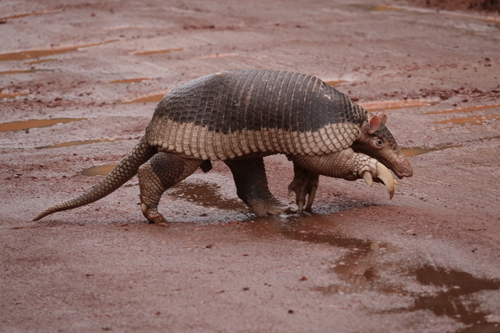
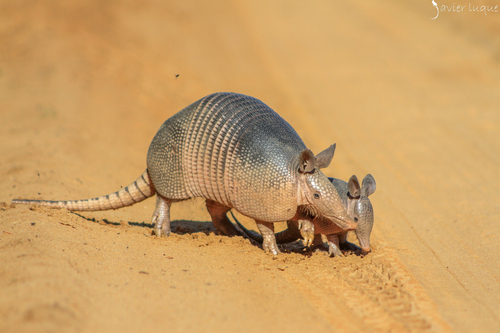
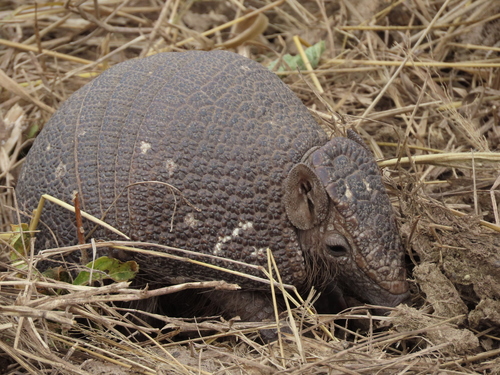
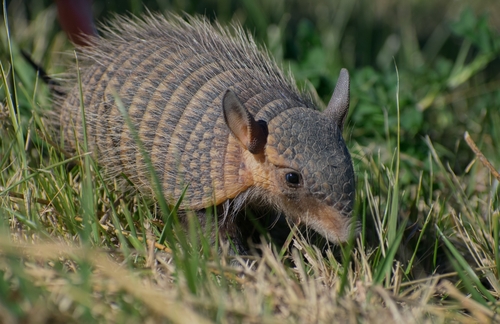
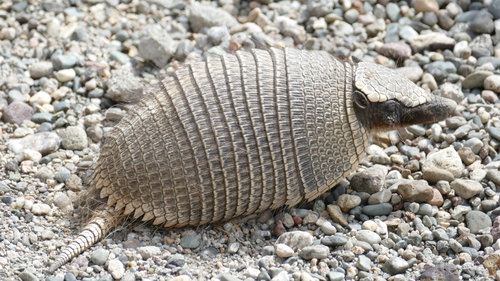
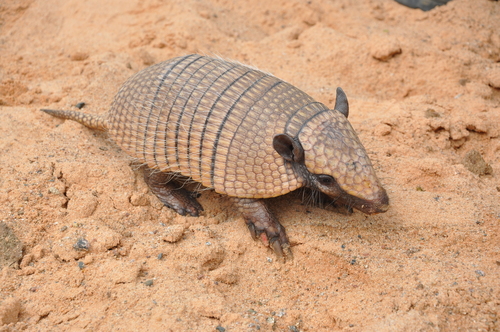
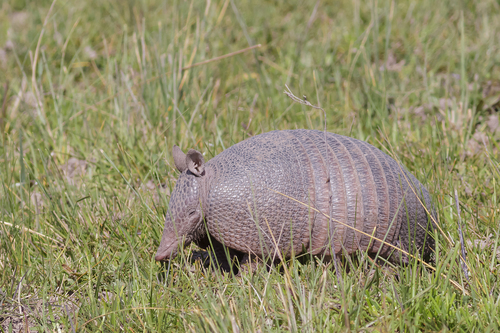
Dasypus septemcinctus, commonly known as the seven-banded long-nosed armadillo, has a broad, flattened body, a bluntly pointed snout, long pointed ears, and short legs. Its protective outer carapace is made up of two fixed plates, separated by six or seven movable bands connected to each other by a fold of hairless skin. The carapace is mostly blackish, hairless, and the scales along the front edge of the movable bands do not differ noticeably in color from the rest of the upper back. Lateral scutes have dark blackish-pink centers that are only slightly distinguishable from the rest of the carapace, and are never as obviously pale as the centers of lateral scutes in the nine-banded armadillo. Scutes on the movable bands are triangular in shape, while scutes on the two main fixed plates are rounded. The number of scutes found on the fourth movable band ranges from 44 to 52, with an average of 48.4. This species has a number of unique biological and neurological features. Its brain has strongly developed sense of smell, large olfactory bulbs, and a large pyriform cortex, all specialized for its carnivorous, nocturnal lifestyle. Additionally, the seven-banded armadillo has a particularly large induseum griseum, a brain structure connected to the olfactory system, which makes it potentially useful for neurobiological research. In terms of reproduction, females of this species give birth to seven to nine genetically identical offspring.