About Dasypterus intermedius (H.Allen, 1862)
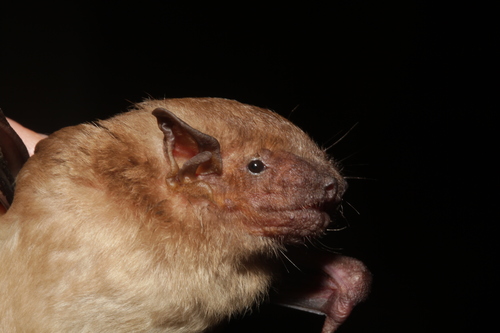
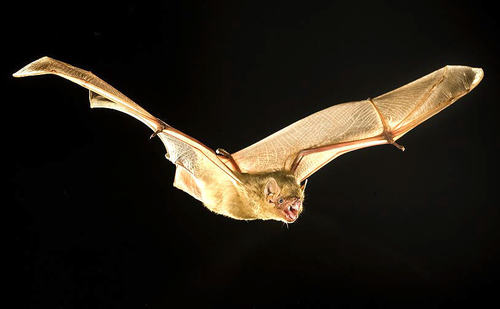
This species, commonly called the northern yellow bat, is larger than the southern yellow bat. It has an average body length of 14 cm, a weight range of 14 to 31 g, and a wingspan between 35 and 41 cm. Its body fur ranges in color from yellow-orange to gray-brown, with dark tips on the hairs. Wing membranes are generally darker than the body, and its forearms are light. Unlike most lasiurine bats, only the front half of its tail membrane is covered in fur, and this species has no white markings on its shoulders or wrists. It is primarily found along coastal regions of the southeastern United States, eastern Texas, Cuba, coastal Mexico, and the Central American countries of Belize, Costa Rica, El Salvador, Guatemala, and Honduras. It is the most abundant bat species in some regions of Florida, and there are a small number of occurrence records from Virginia, North Carolina, and Pennsylvania. The northern yellow bat typically inhabits wooded areas near permanent water sources, or coastal habitats that contain Spanish moss (Tillandsia usneoides) or palm trees. In the southeastern United States, the distribution of D. intermedius almost always coincides with Spanish moss, which the species uses for both roost and maternity sites. These bats roost within Spanish moss itself, or beneath the dead hanging fronds of fan palm trees. A single palm tree or live oak tree draped in Spanish moss may host several individuals year-round. Unlike the solitary nature of most lasiurine bats, multiple pregnant and lactating females of this species can form a maternity colony. One study found that the bats favored Sand live oaks (Quercus geminata), with an average roost height of 2.23 m above the ground and 1.57 m above the nearest vegetation. The average roost was 0.98 m long and 0.44 m wide. Clumps of Spanish moss used as roosts were 2 to 3 times larger than unused clumps of Spanish moss in the same area. All recorded roosts were within 1 m of a sandy road and less than 11 m from a lake. These bats frequently change their roost sites. In August 2003, a male northern yellow bat was found roosting on the underside of a partially dead frond of cabbage palm (Sabal palmetto) along the edge of Lake August on a residential lawn in Florida. The species' cryptic coloration makes it difficult to spot on the brown frond of a palm. Mating occurs during flight in the fall, and occasionally in winter. Although females may develop three or four embryos in the spring, they typically only give birth to twins in late May or early June. If their maternity roost is disturbed, mother yellow bats will pick up their pups and carry them to a safer roost. Baby bats become volant, or able to fly, between June and August. After gaining flight, young bats form evening feeding aggregations with adult females, while adult males remain solitary.