About Dasyprocta mexicana Saussure, 1860
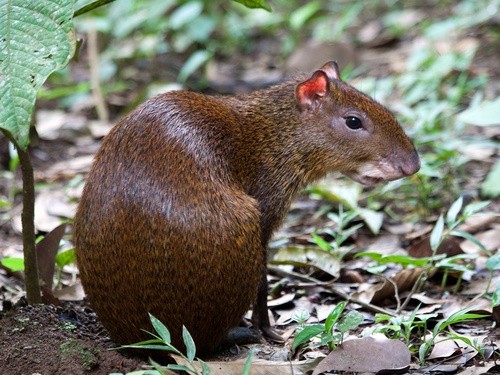
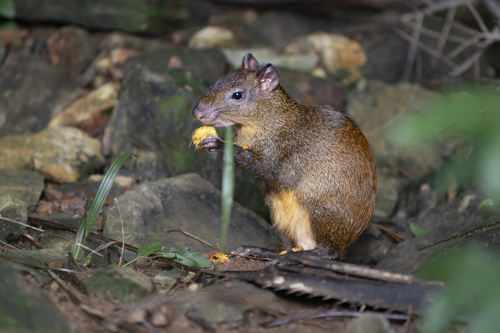
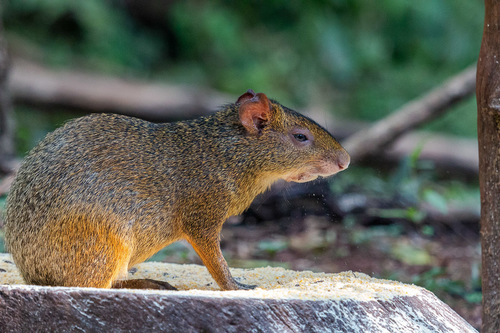
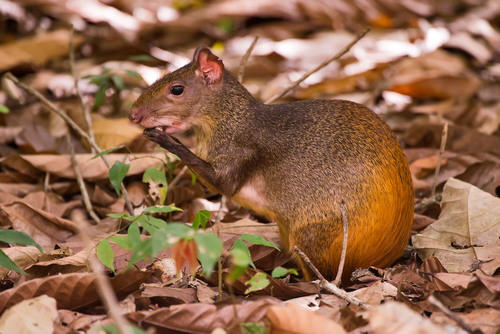
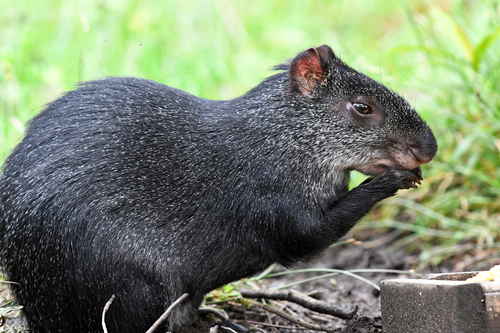
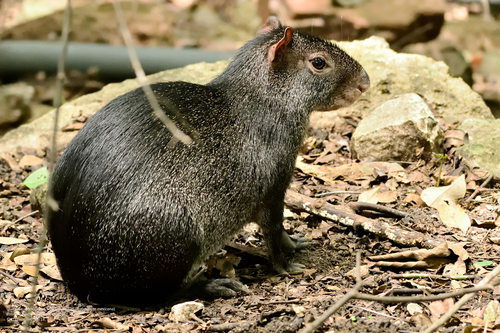
Dasyprocta mexicana (common name Mexican agouti) is a medium-sized rodent. Adult individuals weigh between 2 kilograms and 4 kilograms, and have a total body length from 40 centimeters to 60 centimeters. The short tail, located at the most posterior end of the body, measures 2 centimeters to 3 centimeters long. Most of the species' total length comes from the head and body, which average 44.6 centimeters to 56 centimeters long. Data on the species' height is limited, but it is expected to match the average 23 centimeter height of similar-sized agoutis. The dorsal surfaces of the head and body have a black or dark brown coat, which distinguishes this species from other members of its genus. Sparse white hairs are scattered across this dark coat. Hair length differs across parts of the head and back: the rump and nape have longer, solid black hairs than the rest of the body. The underside of the body, including the chin and throat, has paler, predominantly white hairs, a different coloration from the dorsum. Lighter coloration is also visible around the eyes and at the base of the ears, which measure 3.5 centimeters to 4.7 centimeters long; the exposed skin in these areas appears pink. The overall shape of the species' back is rounded, with two pairs of thin, elongated legs attached at the anterior and posterior ends of the body. The terrestrial lifestyle of agoutis has driven a reduction in digit number and the presence of a vestigial thumb on the claws of these limbs. The smaller anterior limbs are forelegs, which have four arched claw-like digits that help the agouti excavate. The much larger posterior limbs are hindlegs, which are modified to have only three digits. The size difference between hindlegs and forelegs gives agoutis the ability to jump. No sexual dimorphism has been documented for this species, so physical sex distinction can only be done by palpating reproductive organs. Dasyprocta mexicana is a terrestrial species native to Mexico, where it occurs across the Gulf of Mexico lowlands in Veracruz, Oaxaca, Tabasco, and Chiapas. The species' range has expanded, and it is now introduced and extant in western and eastern Cuba. Dasyprocta mexicana lives in terrestrial habitats, and strongly prefers and specializes in humid tropical rainforests, lowland evergreen forests, and second-growth forests. The rodent tolerates a relatively broad elevation range, and has been documented living at elevations between 50 and 600 meters. Limited information is available on how D. mexicana uses its habitat. Research on the closely related, physically similar Central American agouti (Dasyprocta punctata), which shares many life history traits and part of its geographic range with D. mexicana, found that D. punctata centers its home range around key food sources such as fruit trees, and takes refuge in features like tree trunks within its habitat. It is hypothesized that D. mexicana uses its habitat in the same way. Socially, the Mexican agouti has a monogamous mating system, forming breeding pairs for reproduction. Each breeding pair occupies a territory of 1 to 2 hectares. D. mexicana reproduces via viviparity, with an estimated gestation period of 104 to 120 days. The exact age of sexual maturity is not documented for the Mexican agouti, but closely related Dasyprocta species can reach sexual maturity as early as 6 months old. On average, each breeding pair gives birth to 1 or 2 young during the dry season, which runs from March to May. D. mexicana is a scatter-hoarding frugivore, with a diet made up primarily of fruits with soft seeds and new growth from forest plants. Information on the food habits and specific diet components of D. mexicana is limited, but the feeding behaviors of other Dasyprocta species are thought to match those of the Mexican agouti. All Dasyprocta species are confirmed to be frugivores. The wild diet of Dasyprocta leporina is 87% fruit, 6% animal matter, 4% fibrous foods, and 2% leaves, which is predicted to be similar in composition to the diet of D. mexicana. Proportions of each food type vary with fruit season, with diets containing a higher proportion of fruit during peak fruiting. In captivity, Dasyprocta species show a preference for high-energy, low-water content foods, though little is known about the specific dietary requirements of agouti species. Food items wild Dasyprocta species have been observed eating include: citrus fruit, coconuts, avocado, mango, pineapple, tomato, papaya, melon, queen palm, leaves, flowers, roots, corn, rice, almonds, black palm, Brazil nuts, dry palm pyrenes, and invertebrates. Dasyprocta species capture and store food via scatter-hoarding behavior: after removing fruit pulp, individual seeds and nuts are cached separately. Cached seeds are usually retrieved after the fruiting season, with retrieval documented up to 8 months after initial burial. Caching involves burying seeds in holes 2 to 8 centimeters deep, then covering the holes with soil and leaf litter for protection. In the wild, pregnant Dasyprocta individuals have been recorded increasing the amount of seeds in their diet, which raises the protein, fat, and energy content of their food. After collecting food, Dasyprocta species rely on generalized rodent dentition to process and break down food items, with a dental formula of I 1/1, C 0/0, P 1/1, M 3/3. To resist compressive strain and maintain a sharp edge for shaving and chiseling food, Dasyprocta incisors grow continuously and have restricted enamel on their anteroventral surface. Two main jaw occlusion types occur during feeding: first, contact between the cheek teeth to masticate plant and animal foods, and second, contact between the incisors to assist with gnawing and chewing. Upper and lower incisors serve different roles: upper incisors cut plant matter and pierce animal food sources, while lower incisors cut and shear food.