About Dasypoda hirtipes (Fabricius, 1793)
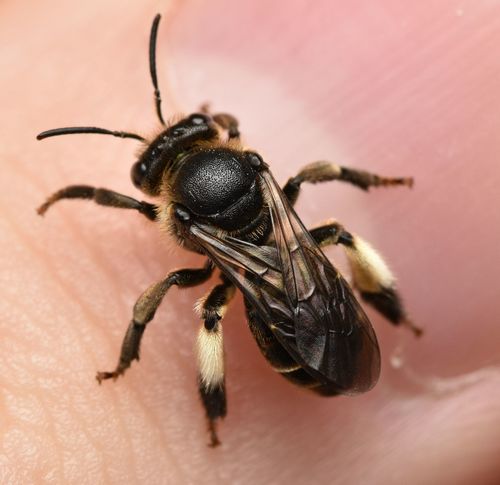
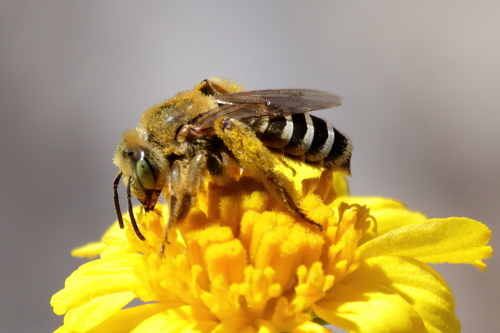
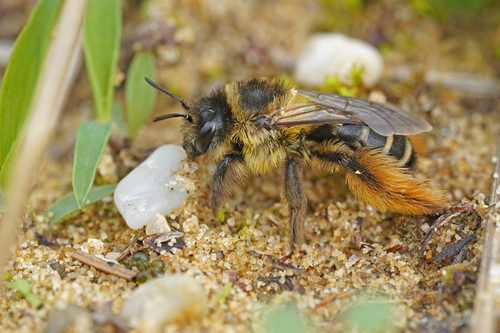
Dasypoda hirtipes gets one of its common names, the pantaloon bee, from the females' hirsute hind legs. When the bee forages, pollen collects in the golden hairs of the hind tibiae, swelling the legs so they look like the bee is wearing pantaloons. These distinctive "pantaloons" make females very easy to identify. Otherwise, this is a medium to large bee with yellowish-brown colouration on the thorax, and its abdomen is banded with black and golden-brown. Males are less distinctive. Their abdomen matches the female's in pattern, but their entire body is covered in long brown hairs. Their legs have longer hair than most bees, but they do not develop the "pantaloons" females have. As males age, sun exposure can fade their body colour to silvery-white. Dasypoda hirtipes occurs across Eurasia, ranging from southern Britain to China. Its range extends north to southern Finland and southern Scandinavia, and south to North Africa and the Canary Islands. Within Britain, it is found in southern England as far north as Norfolk and in western Wales; it also occurs on Jersey and Guernsey in the Channel Islands. Dasypoda hirtipes prefers exposed sandy areas, including shrubby Mediterranean vegetation and temperate grasslands, but it is also common in urban and suburban areas. In Britain, its preferred habitats are sandy heathlands and coastal dunes. Females dig nesting burrows in sandy soil, and frequently nest in large congregations, although each female tends only to her own nest. The main shaft of the burrow is quite long, measuring between 8 and 60 centimetres (3.1 and 23.6 in). Females dig the main shaft at an oblique angle, which leaves excavated spoil deposited in a fan shape to one side of the burrow entrance. Females dig side tunnels branching off the main shaft at the end of the shaft. In Denmark, females excavate their nests in the afternoons, and rarely leave their burrows after early afternoon. The hairy "pantaloons" help females excavate nests, in addition to their function carrying pollen. These bees primarily forage on flowers in the family Asteraceae, especially yellow composite flowers such as hawk's beards, ragworts, common fleabane, hawkbits, cat's ear and oxtongues. Flesh flies in the genus Miltogramma appear to be significant parasitoids targeting the nests of D. hirtipes. In Britain, the flight period of D. hirtipes runs from June to late August.