About Dasyornis broadbenti (McCoy, 1867)
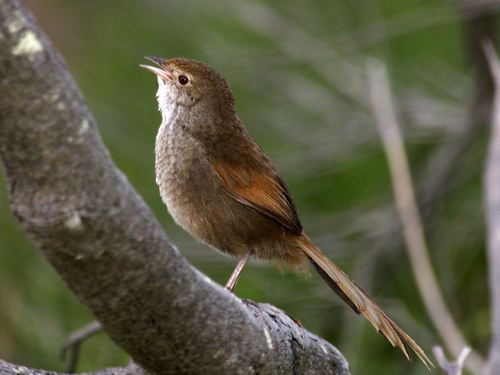
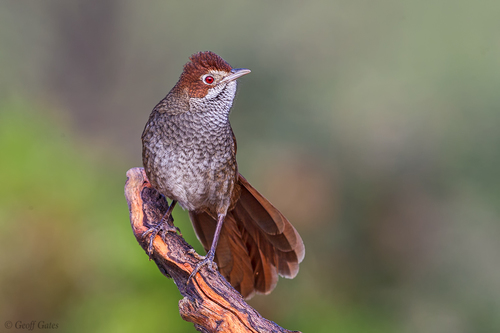
The rufous bristlebird, Dasyornis broadbenti, is a medium-sized bird weighing approximately 77 grams. It is predominantly brown, with a long tail and short rounded wings. Its head and ear coverts are a rich rufous color. Its mantle, back and neck are dark brown with a faint reddish wash, and its rump is red-brown. A light grey marking surrounds the bird's eye and extends to the bill. Its eyes are reddish, and its legs and feet are dark brown or grey-brown. It has a whitish throat marked with dark scalloping, and a grey-brown breast also marked with scalloping. Scalloping is dark in the eastern part of the species' range, and white in the western part. It is similar in size to a blackbird, but is distinct due to its long tail, acoustic signals, and rufous coloration.\nRufous bristlebirds are distributed across Australia. While they formerly ranged through southern Western Australia, they now only live in coastal regions of western Victoria and south-eastern South Australia. Well-known locations for the species include areas near the Murray River mouth in South Australia, and Portland and Port Fairy in Victoria. This species has a slow recolonization rate. Individuals have also been found in heathlands, on coastal clifftops, and in low-lying forested valleys of the Otway Ranges in south-western Victoria.\nThe first recorded observations of rufous bristlebirds in South Australian heath after regional wildfires came in 1981 and 1985, at Salt Creek – one of the few lightly-burnt areas in the region, which likely provided safe shelter and suitable habitat. Their preferred habitat is dense shrubland and heathland with a diverse mix of plant species. They are also commonly found in forests with an understory of bracken, shrubs, or both. The bird can be seen running or flying short distances, darting through the dense understory where it shelters and feeds. It also lives near thick, natural vegetation, and vegetation structure is a strong predictor of suitable habitat for the species.\nAs a group, bristlebirds often occupy habitats dominated by environmental weeds. Acacia sophorae and Leptospermum laevigatum are weeds that match the vegetation structure requirements of bristlebirds, including rufous bristlebirds, so these weeds must be considered in stable management planning for the species' future habitats.\nAround the Victorian west coast town of Portland, the rufous bristlebird population appears to be stable. The area surrounding the Portland Aluminium refinery is called Portland Heathland, and it consists of ecologically diverse coastal heathland and shrubland with a range of vegetation communities, making it ideal for the species' preferred habitat. Portland's habitat is similar to the habitat of the eastern Victorian subspecies Dasyornis broadbenti caryochrous, which supports conservation management plans tailored to both remaining subspecies of rufous bristlebird. One study estimated there were 70 to 86 individual rufous bristlebirds within a 170-hectare survey area in Portland, south-western Victoria.\nFurther studies in Victoria have found that rufous bristlebirds prefer relatively low-altitude areas near coastal edges and drainage systems, with dense vertical vegetation structure. One study found 70% of observed rufous bristlebirds were located within 100 meters of drainage lines, which suggests water features provide the denser vegetation and moister soil the species prefers, due to limited sunlight in these areas. In 2006, most detections (around 60%) were of birds located less than 2 km from the coast, though the species has been found up to 5 km inland.\nThe two remaining subspecies, D. b. broadbenti and D. b. caryochrous, are separated by approximately 100 km in South Australia. Since 1984, 76 records of rufous bristlebirds have been collected in Coorong National Park, South Australia, and the species has also been detected in six remnant patches of native vegetation outside the park. Agricultural and urban development is a major threat to the Otway subspecies D. b. caryochrous. Additionally, the flammable nature of the species' habitat puts it at risk of habitat loss and destruction from wildfire.