About Dasyatis pastinaca (Linnaeus, 1758)
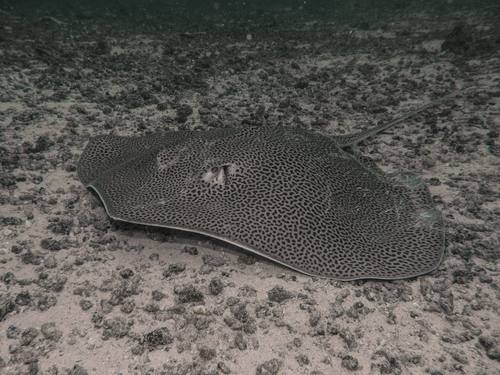
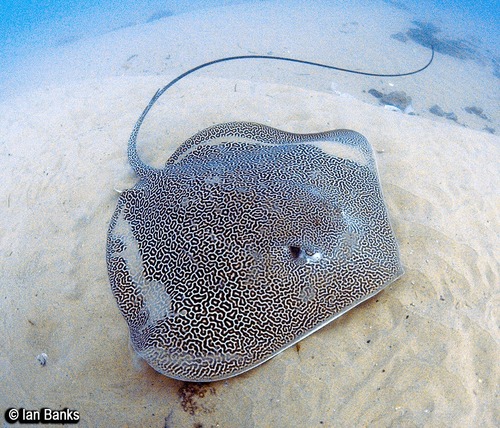
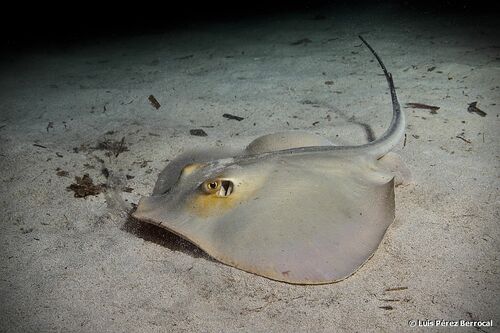
The common stingray Dasyatis pastinaca has been reported to reach a maximum disc width of 1.4 m (4.6 ft) and a total length of 2.5 m (8.2 ft), though a 45 cm (18 in) disc width is more typical for the species. Its flattened pectoral fin disc is diamond-shaped, slightly wider than it is long, and has narrowly rounded outer corners. The leading margins of the disc are almost straight and converge to form a pointed, slightly protruding snout, while the trailing margins of the disc are convex. The species' eyes are smaller than its spiracles, which are paired respiratory openings that sit closely behind the eyes. Common stingrays have between 28 and 38 upper tooth rows, and 28 to 43 lower tooth rows; their teeth are small and blunt, arranged into flat surfaces. Five nipple-like structures called papillae extend across the floor of the mouth. The tail is slender and whip-like, measuring around half the length of the disc. A strongly serrated stinging spine up to 35 cm (14 in) long, which has a venom gland at its base, is positioned roughly one-third of the way along the tail. Because the spines are regularly replaced, and new spines begin growing before existing spines are shed, a second or even third spine may be present at the same time. Behind the spine, the tail has a low skin fold on its upper surface, and a short, deep fold on its underside. The body and tail are mostly smooth, with only a few dermal denticles found on the leading edge of the disc. Older individuals may also develop a row of bony knobs along the midline of their back. The upper body of this species is solid gray, brown, reddish, or olive-green, while the underside is whitish with dark fin margins. Young rays may have white spots on their bodies. The largest common stingray specimen ever recorded was found in 2016 in İzmir Province, Turkey during a trolling study. This specimen had a disc width of 2.21 m (7.3 ft), but its total length could not be measured because the tail had been removed before the specimen was found. The common stingray is found across the entire Mediterranean and Black Seas. It also occurs in the northeastern Atlantic Ocean from southern Norway and the western Baltic Sea to Madeira and the Canary Islands, though in much lower population numbers there. This bottom-dwelling species can be found from the shoreline down to a depth of 200 m (660 ft), but it is not usually found deeper than 60 m (200 ft). It prefers sandy or muddy bottoms in calm water, and is sometimes also found near rocky reefs or in estuaries, as it can tolerate environments with low salinity. Off the Azores, common stingrays are most abundant in summer and least abundant in winter, which suggests the species makes seasonal shifts in range or depth, a pattern that has already been documented in other ray species. Common stingrays are encountered either alone or in social groups. The species appears to partially segregate by sex, and is likely more active at night. During the day, it tends to bury itself in sediment. It feeds on a wide variety of bottom-dwelling organisms, including crustaceans, cephalopods, bivalves, polychaete worms, and small bony fishes. It has been reported to cause major damage to cultured shellfish beds. One study conducted in the Gulf of İskenderun off Turkey found that crustaceans made up roughly 99% of the common stingray's diet, with fish prey becoming more important as individual rays age. Another study off the coast of Tarsus, Turkey found that the penaeid shrimp Metapenaeus stebbingi was the most important dietary component for the species, followed by the pistol shrimp Alpheus glaber and the swimming crab Charybdis longicollis. Cephalopods were relatively more important in the diet of males, while fishes were more important for females. Common stingrays have been observed following one another closely when food is present, possibly to take advantage of the foraging success of other individuals. Like other stingrays, the common stingray is aplacental viviparous: embryos are first sustained by yolk, and later the yolk is supplemented by histotroph, also called uterine milk, which is enriched with proteins, fat, and mucus. This nutrient fluid is delivered by the mother through numerous extensions of the uterine epithelium called trophonemata. Females produce two litters of 4 to 9 pups per year in shallow inshore waters, after a four-month gestation period. Multiple sources have generally reported birthing occurs in summer, between May and September, or within a narrower window such as July to August. Mature common stingrays are known to aggregate off the Balearic Islands from mid-June to July, likely for reproductive purposes. Newborn rays have a disc width of around 8 cm (3.1 in) and a total length of 20 cm (7.9 in). Males reach sexual maturity at a disc width of 22 to 32 cm (8.7 to 12.6 in), while females reach sexual maturity at a disc width of 24 to 38 cm (9.4 to 15.0 in). The oldest known wild individual was ten years old, but the species has been recorded living up to 21 years in captivity. Known parasites of the common stingray include the flukes Heterocotyle pastinacae and Entobdella diadema, and the tapeworm Scalithrium minimum.