About Dascyllus aruanus (Linnaeus, 1758)
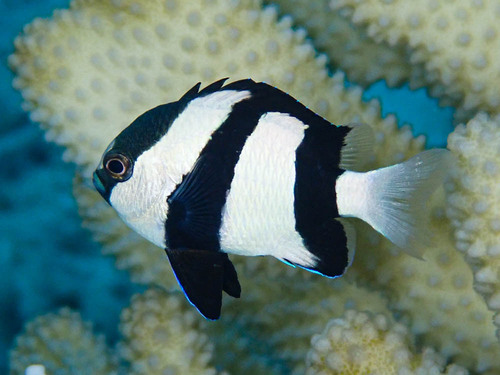
Whitetail dascyllus (Dascyllus aruanus) reaches a maximum total length of 10 centimetres (3.9 in), with a common adult size of 6 centimetres (2.4 in). Its body is white with three black vertical bars, and has a small mouth, a flat spine, and a large white spot between the eyes. It closely resembles the closely related species D. abudafur, and may also be mistaken for D. melanurus, which has four black stripes instead of three. Body coloration does not change across its lifespan, and the bold black-and-white contrast is hypothesized to serve two purposes: attracting conspecifics, and signaling that the fish’s host coral is toxic to potential predators. This species grows to about 6 centimetres in its first year of life, reaches full adult size by the end of its second year, and lives for another three to four years at its maximum 10-centimetre length before dying. Whitetail dascyllus is associated with coral reefs, and most often occurs in groups above the heads of Acropora corals. This species, also called the black and white damselfish or humbug damselfish, maintains a symbiotic relationship with its host coral reef: the fish receives shelter from the reef, and exchanges nutrients in return. As a planktivore, it acts as a "gardener" by grazing on unwanted algae, and excretes waste in the form of phosphate and ammonium that benefits the coral. To stay within the safety of the reef, the humbug feeds on nearby waste and small prey. Dascyllus aruanus is native to the Indo-Pacific, where it occurs east and north of the Sunda Shelf. It lives in small groups of around 30 individuals, and prefers small territories in shallow coral reefs between 1 and 10 meters deep. Individuals rarely stray far from their birth home. The coral reefs they inhabit are most often small, with lower species diversity. Humbug damselfish are highly territorial, and will act to protect their coral shelters. They can cohabit efficiently with Dascyllus marginatus in the same coral, having adapted similar behaviors and do not treat one another as competitors. Unlike many other fish species, black and white damselfish do not have a defined spawning season, and mating occurs daily. Females may mate with multiple males, and can produce a new batch of up to 2000 eggs every two days. Males court females constantly. Non-random mating is selected by females, so only male preference affects spawning consistency, and multiple factors shape female selection of a male. Courting behavior and mate copying are the two dominant behaviors linked to female preference. Mate copying occurs when a female chooses to mate with a male that has already mated with another female recently. Males with higher courtship rates have higher reproductive success. To attract mates, males perform a "signal jump": they quickly rise up the water column before swimming back down. Recently mated males are also more likely to mate again with a new female. Females prefer to spawn at nesting sites that already hold eggs, as this indicates the male is higher quality and has successfully spawned with another female. This mate copying strategy reduces the energy females spend on choosing a mate, lowers the chance of selecting a low-quality male, and increases a female’s reproductive rate and success. Males are highly territorial of their nesting sites, and act aggressively toward other males during courtship. After spawning is complete, males build and guard the nests. This consistent, efficient reproductive system is thought to be a major contributor to the stable conservation status of Dascyllus aruanus.