About Darwinia biflora (Cheel) B.G.Briggs
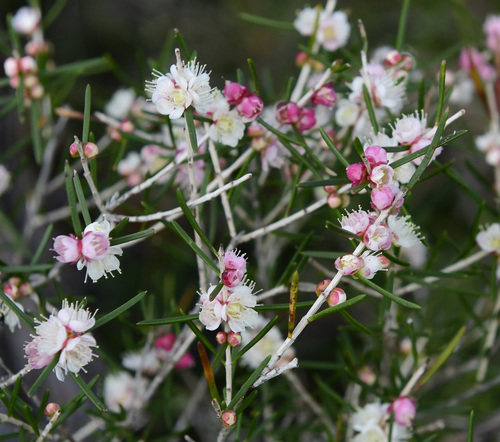
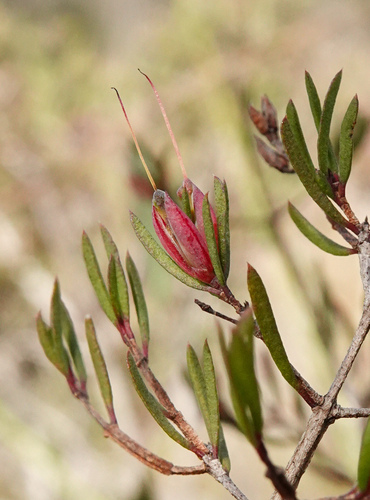
Darwinia biflora is an erect, sometimes spreading, often straggly shrub that grows to a height of 0.2–0.8 metres (0.7–3 ft). Its leaves are glabrous, arranged in a decussate pattern along the branches, 6–10 millimetres (0.2–0.4 in) long, flattened, and often pressed against the branches. Flowers grow on stalks less than 1 millimetre (0.04 in) long near the ends of branches, usually in pairs. When open, the flowers are tubular: upper parts are white to pink, and the floral tube is green. The flower tube is 5–8 millimetres (0.2–0.3 in) long. It is surrounded by leaf-like bracts 1–8 millimetres (0.04–0.3 in) long, and two purple-red bracteoles 5–8 millimetres (0.2–0.3 in) long that fall off after the flower opens. Stamens and staminodes are enclosed within the flower tube, but the style is 10–14 millimetres (0.4–0.6 in) long, yellow-green or red, straight or slightly curved, and projects out of the tube. Flowering occurs throughout the year, mainly between May and August, and is followed by a fruit that is a nut around 1–1.5 millimetres (0.04–0.06 in) in diameter. Although herbarium specimens of this species have been collected from areas further away, all current populations are found in the Sydney urban region, between Maroota and North Ryde. It grows in heath on sandstone ridge tops, or in woodland where sandstone transitions to shale. Of the 240 known sites where this species occurs, 90 are located in national parks or other reserves, while the remainder are in habitats often selected for residential development. Individual Darwinia biflora plants are estimated to live 15 to 20 years. The plants usually self-pollinate, and insect visitors to the flowers have rarely been observed. Seed does not usually form until plants are around 5 years old, but seed viability is high. While fire kills mature plants, many new seedlings emerge after fire.