About Darlingtonia californica Torr.
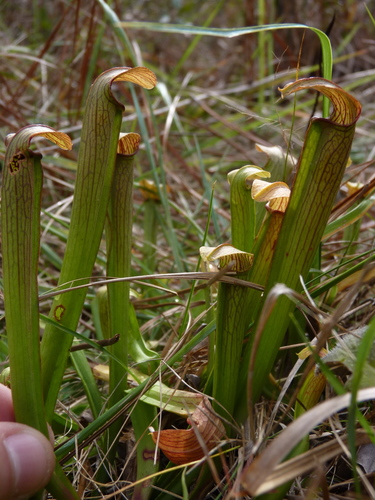
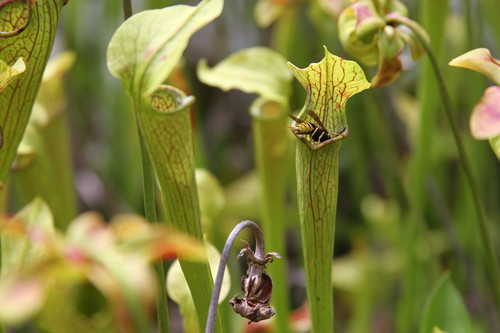
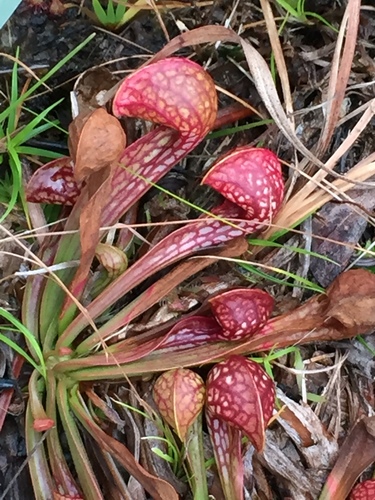
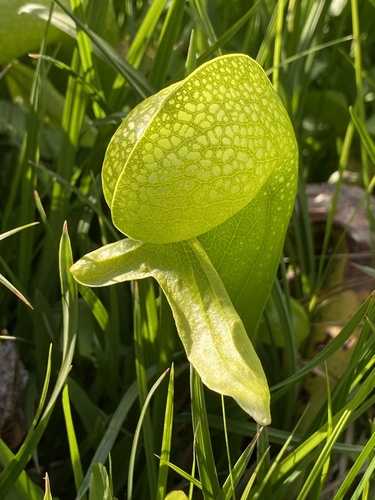
Darlingtonia californica Torr. is a carnivorous plant species in the New World pitcher plant family Sarraceniaceae. It is the only species in the monotypic genus Darlingtonia, and is commonly known as cobra lily, cobra plant, California pitcher plant, Oregon pitcher plant, or Cascadian pitcher plant. The common name cobra lily comes from its tubular leaves, which resemble a rearing cobra; the plant has a forked leaf that ranges from yellow to purplish-green and looks like fangs or a serpent’s tongue.
This species is native to Northern California and Oregon in the western United States. Its native climate is generally cool and humid, but it can also be quite arid for multiple months each year, more aridity than many other carnivorous and pitcher plant genera such as Heliamphora, Nepenthes, or Sarracenia can survive. Through carnivorous adaptations, the species has evolved to live along the West Coast and in the lower Pacific Northwest. It can typically be found growing near bogs, vernal pools, forested rocky slopes especially close to snowmelt, creeks, or seeps with cold running water, most often on serpentine soils. It has even been observed growing in drainage ditches and on roadsides. While it is fairly commonly cultivated, Darlingtonia californica is considered uncommon due to its rarity in the wild.
The species was first discovered in 1841 during the Wilkes Expedition by botanist William D. Brackenridge at Mount Shasta, Northern California. It was formally described in 1853 by John Torrey, who named the genus Darlingtonia in honor of Philadelphia botanist William Darlington (1782–1863). Cultivars grown in the United Kingdom have earned this plant the Royal Horticultural Society's Award of Garden Merit.
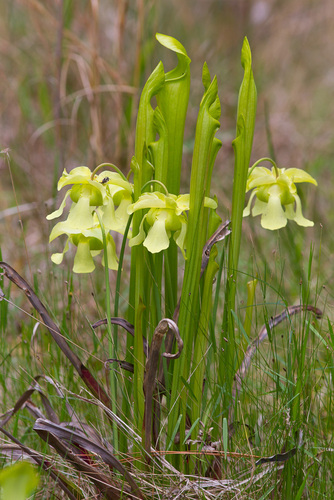
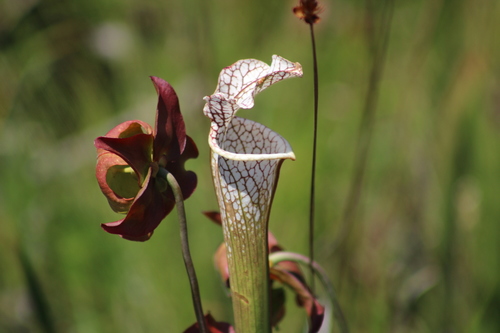
For many years, the pollination mechanism of the cobra lily has remained a mystery. Its unusually shaped, complex flower is generally a sign of close specialization between plant and pollinator. The flower is yellowish purple, and grows on a stalk that is slightly taller than the plant’s pitcher leaves. It has five green sepals, which are longer than the plant’s red-veined petals. Prior to 2011, it was generally expected that the pollinator was either a fly or bee attracted to the flower’s unpleasant smell, or some type of nocturnal insect.
A 2011 study suggested the species is melittophilous (bee-pollinated), after observations of the miner bee species Andrena nigrihirta visiting flowers. Hand pollination produced poor results, which supports the likelihood of melittophily given the fruit’s complexity. The study noted that observations of A. nigrihirta on flowers showed the shape and orientation of D. californica’s ovary and petals promote stigma contact both when pollinators enter and exit the flower, which contradicts previous thinking. The study’s findings confirmed that D. californica is melittophilous. The study also found that Darlingtonia was pollen-limited in all five observed plants. However, Darlingtonia was still able to reproduce when no male plants were present, which suggests that self pollination may also play a role. It appears both pollination methods occur, which adds to the species’ reputation for hardiness in the wild.
Darlingtonia californica can be difficult to maintain in cultivation, because it requires specific environmental conditions. It prefers cool to warm daytime temperatures, and cold or cool nighttime temperatures. In the wild, cobra lilies typically grow in bogs or on streambanks fed by cold mountain water, and grow best when their roots are kept cooler than the rest of the plant. In cultivation, it is best to mimic these natural conditions, and water the plants with cold, purified water. On hot days, placing ice cubes made from purified water on the soil surface helps meet the plant’s needs. Cobra lilies prefer full sun when grown in humid, warm locations, and prefer partial shade when humidity is low or fluctuates frequently. Plants can adapt to low humidity, but optimal growth occurs at moderate humidity levels.
Growing cobra lilies from seed is extremely slow, and cobra seedlings are difficult to maintain, so the plants are most easily propagated from the long stolons they produce in late winter and spring. When a tiny new cobra plant becomes visible at the end of a stolon, usually in mid to late spring, the entire stolon can be cut into sections a few inches long, each with a few roots attached. These sections are laid on top of cool, moist, shredded long-fibered sphagnum moss and placed in a humid location with bright light. After several weeks, new cobra plants will grow from each stolon section.
Like many other carnivorous plants from temperate regions, cobra lilies require a cold winter dormancy for long-term survival. During very cold winters, plants die back to their rhizomes; in cool winters, they retain their leaves through dormancy. This dormancy period lasts 3 to 5 months each year, and all growth stops during this time. As spring arrives, mature plants often produce a single nodding flower, and a few weeks later the plant grows a few large pitchers. The plant will continue producing pitchers through the summer, though these summer pitchers are much smaller than the early spring pitchers. Many carnivorous plant enthusiasts have succeeded in cultivating this species, and three color morphs have been developed or discovered: all green, all red, and red-green bicolor. Wild-type plants are all green in moderate light, and bicolor in intense sunlight.