About Dardanus megistos (J.F.W.Herbst, 1804)
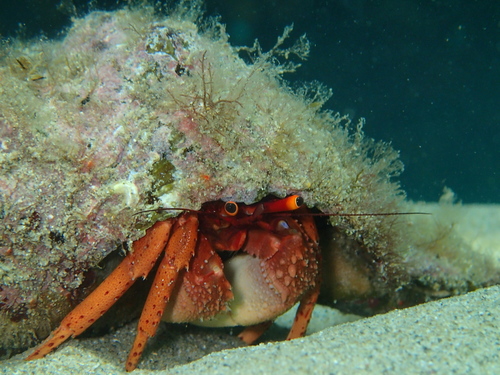
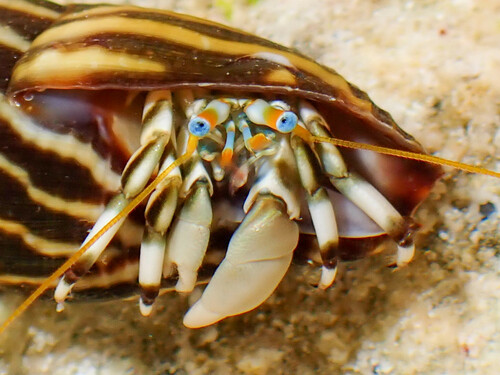
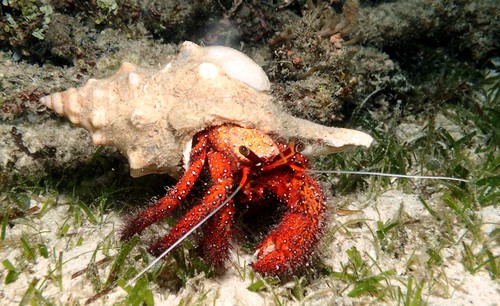
Dardanus megistos can reach a body length of approximately 20 centimeters (7.9 inches). These large crabs have a bright red body marked with small white eyespots that are each surrounded by black. Their entire body is covered in long, erect, coarse dark red hairs. They have one pair of long white primary antennae (also called antennules), one pair of secondary antennae, stalked greenish-brown eyes, and three pairs of mouth appendages. The eye stalks are reddish, with a white spot at their base. The soft, asymmetrical abdomen is spiral-shaped, an adaptation that lets it fit inside a gastropod shell, and ends in a five-piece tail made up of the telson and uropods. Like all decapod crustaceans, Dardanus megistos has ten legs. The first pair of legs bears the pincers, called chelipeds, and the left pincer is larger than the right one. This species is found in the Indo-Pacific region, ranging from East Africa to the South China Sea, Australia, and eastward to Hawaii. These tropical reef-associated hermit crabs live in coral reefs, lagoons, rocky platforms, sandy areas, and seagrass beds. They occur from the littoral and subtidal zones down to deep waters, reaching depths of up to 50 meters.