About Daptrius ater Vieillot, 1816
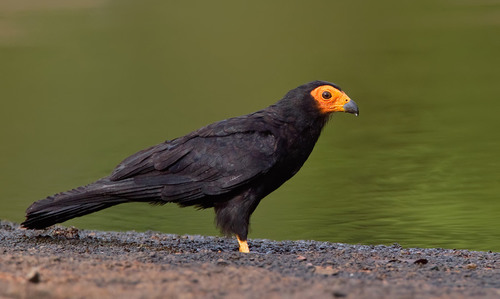
Description: Adult black caracaras (Daptrius ater) have glossy black plumage overall, with a distinctive white band at the base of the tail, and yellow to orange-red feet and face. Adults are similar in appearance to their closest relative, the red-throated caracara, but black caracaras have distinctly long and narrow wings and tail, along with a black beak. Red-throated caracaras can be easily told apart from black caracaras by their red throats. The average adult length of Daptrius ater is 41–47 cm (16–19 in). Females of this species average 350–440 g (12–16 oz), and are typically larger than males, which have an average weight of 330 g (12 oz). Juveniles can be identified by their dull black plumage, pale yellow face, and 3 to 4 black bars on the rectrices. When observed in flight from a distance, Daptrius ater notably rarely soars, and instead is seen flying with continuous flapping.
Distribution and habitat: Daptrius ater is found in Bolivia, Brazil, Colombia, Ecuador, French Guiana, Guyana, Peru, Suriname, and Venezuela. Its natural habitats are subtropical or tropical moist lowland forest and heavily degraded former forest. Common habitats include gallery forest and wooded savanna located between 0 and 900 m (0 to 2,950 ft) in elevation. Black caracaras can also be found in mangroves and disturbed forested habitats along water.
Food and feeding: The black caracara eats almost anything, ranging from vegetation to carrion to live prey, so it is best described as an opportunistic omnivorous predator. More specifically, its diet may include nestlings and fledglings of many other bird species, adult smaller birds (such as flycatchers, parrots, and pigeons), small mammals, frogs, lizards, snakes, many invertebrates, small fish, palm nuts, and numerous varieties of fruit. With this diverse diet, black caracaras have developed many unique foraging and hunting strategies: these include directly attacking the nests of other birds, searching canopy foliage with their beaks for insects, showing no fear around humans while scavenging near towns or garbage sites, and foraging for small fish in their riverine habitats. To fish, black caracaras use exposed rocks and emergent vegetation in and along rivers, walking slowly on these surfaces while peering into the water for small fish such as species in the Characidae family. Once prey is spotted, it is caught using either the bill or talons, then carried away from the river to be eaten. Black caracaras mostly fish in areas of fast-moving rivers where migratory fish are forced into bottlenecks and become trapped among plants or in shallow pools, which reflects their opportunistic nature.