About Daphniphyllum macropodum Miq.
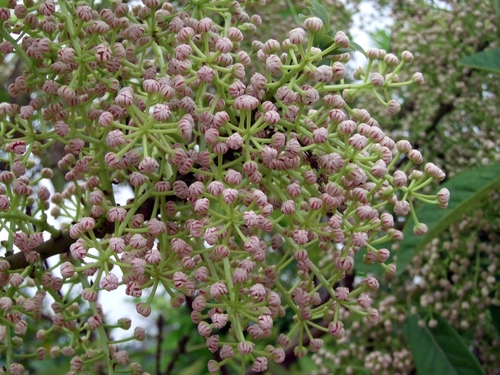
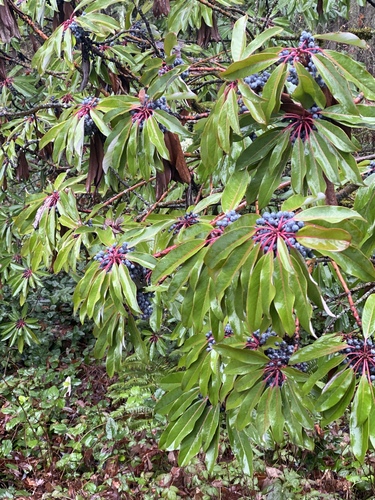
Daphniphyllum macropodum Miq. is typically a small tree or shrub, growing 3–10 meters (10–33 feet) tall, though it may occasionally reach 20 meters (66 feet) in height. Its long leaves measure 14–25 cm (6–10 in) in length and 3–6.5 cm (1–3 in) in width, and they have purplish red petioles (leaf stalks) and clearly visible veins. Leaves are arranged in a tight spiral pattern, forming a structure that closely resembles whorls at the tips of branches. Very young branches are red, and they turn brown as they age; mature trunks are greyish brown. Inflorescences (flower clusters) grow from leaf axils on growth produced the previous year. Each cluster has a pink bract at its base that fully encloses the cluster when young, leading to a description that compares them to "miniature tissue-wrapped bunches of grapes". The tiny, bad-smelling flowers do not have sepals or petals. Individual plants are either male or female: each plant produces flowers that have either only functional stamens or only functional ovaries. Male flowers have 6–12 pink stamens that are around 3 mm (0.1 in) long. Female flowers have a single green ovary 2–3 mm (0.1 in) long, and sometimes also bear nonfunctional stamens called staminodes. After fertilization, female flowers develop into purplish brown drupe fruits, which are around 1 cm (0.4 in) long. Like other species in its genus, Daphniphyllum macropodum can be cultivated as an ornamental evergreen shrub or small tree. Its most valued ornamental features are its large leaves and new growth with a pink tint. It is recommended to grow this plant in a sheltered location with moist, well-drained soil. Newly emerged shoots are easily damaged by frost. While it grows into a small tree in its natural habitat, it most often forms a well-branched shrub when grown in gardens. It can be propagated from heel cuttings or fresh seed. Documented uses of this species include: the Ainu people of Japan and Siberia dry and smoke its leaves; in China, a decoction of fresh leaves mixed with either straw ash and water or fresh pumpkin leaves is strained to make grass jelly; in Korean folk medicine, the leaves and bark are used to treat acute pleurisy and peritonitis, to induce diuresis, and the water the leaves are boiled in is used as an antihelminthic.