About Daphniphyllum calycinum Benth.
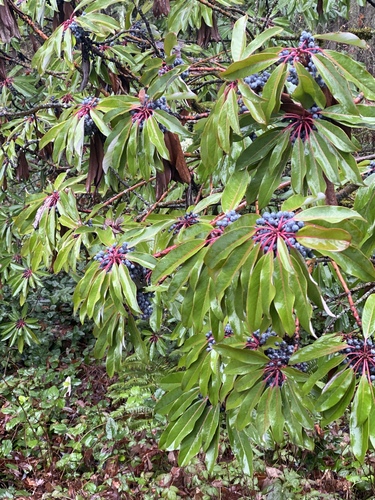
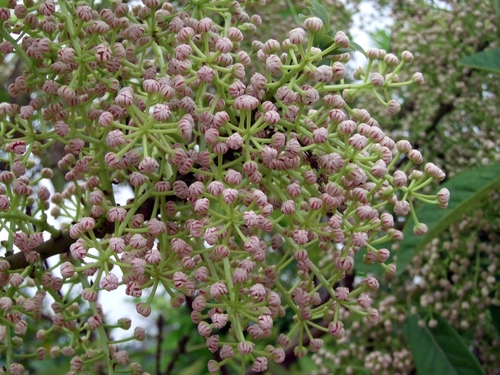
Daphniphyllum calycinum Benth. is a shrub that grows 1.5 to 4 meters tall. Its grayish-brown branches have sparse lenticels. Petioles measure 4 to 8 cm long. Leaf blades are obovate to obovate-elliptic, 12–16 cm long by 4–9 cm wide, chartaceous, glaucous and hairy, with inconspicuous papillae on the lower surface. Leaves have a broadly cuneate base, slightly reflexed margins, and an obtuse to rounded, mucronate apex. 8 to 11 pairs of lateral veins are visible on the upper leaf surface and prominent on the lower surface. Male flowers grow on 8–10 cm pedicels, and have a discoid calyx with 3 or 4 broadly triangular lobes, plus 9 or 10 stamens about 3 mm long with very short filaments. Stamens have oblong, laterally compressed anthers, with an exserted connective. Female flowers grow on 5–6 mm pedicels, and have broadly triangular calyx lobes around 1.5 mm in size, an ellipsoidal ovary 1.5–2 mm in size, a very short style, and 2 recurved stigmas. The infructescence, or fruiting head, is 4–5 cm in size, and is densely arranged with ovoid-ellipsoidal, tuberculate, glaucous drupes around 7 by 4 mm in size, that retain persistent calyx and style branches. This species flowers from April to June, and fruits from August to November. Key distinguishing characteristics for this species are the 9–16 cm by 4–9 cm size and obovate to obovate-elliptic shape of the leaf blade, the obtuse to rounded leaf apex, and the approximately 7 mm size, dense arrangement, and glaucousness of the fruit. This plant is native to the region spanning from northern Vietnam to southeastern China, specifically including Fujian, Guangdong, Guangxi, Hong Kong, southern Hunan, and southern Jiangxi. This shrub grows in forests and thickets, occurring occasionally below 100 m in altitude, but most commonly between 200 and 700 m. It grows in degraded hillside shrublands in Hong Kong, where it is common in scrubland and forest edges. Birds disperse its seeds, which are produced during the dry fruiting season. The follicular micromycete (sac fungus) Mycosphaerella fasciculata, a member of the family Mycosphaerellaceae, uses this species as a host. Seeds of this plant produce abundant oil that was historically used for lubrication and to make refined soap; more recently, due to its toxicity, the oil is only used to produce biodiesel. Roots and leaves of the plant are used in Chinese medicine. This species contains many alkaloids and other active ingredients; for more information on this, see Wu et al., 2013.