About Danio rerio (Hamilton, 1822)
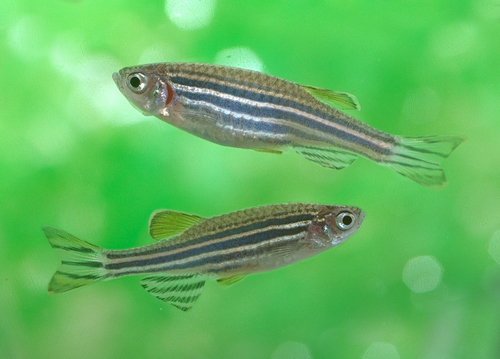
The zebrafish (Danio rerio) gets its common name from five uniform, pigmented, horizontal blue stripes that run along the side of its body, all the way to the end of the caudal fin; these stripes resemble the stripes of a zebra. Zebrafish have a fusiform, laterally compressed body shape with an upward-oriented mouth. Males are torpedo-shaped, with gold stripes between their blue stripes, while females have a larger whitish belly and silver stripes instead of gold. Adult females develop a small genital papilla in front of the origin of the anal fin. Zebrafish can grow up to 4–5 cm (1.6–2.0 in) in total length, though wild individuals typically reach 1.8–3.7 cm (0.7–1.5 in), with size variation across locations. In captivity, zebrafish generally live two to three years, and can live over five years in ideal conditions. In the wild, the species is typically annual, meaning individuals usually complete their life cycle within one year. As a model biological system, zebrafish offer many advantages for scientific research. Its genome has been fully sequenced, covering approximately 1.4 billion base pairs, and the species has well-understood, easily observable and testable developmental behaviors. Embryonic development in zebrafish is very rapid, and embryos are relatively large, robust, transparent, and develop outside the mother’s body. In addition, well-characterized mutant strains are readily available for research. Other benefits of using zebrafish include their nearly constant body size during early development, which allows the use of simple staining techniques, and the ability to fuse two-celled embryos into a single cell to create a homozygous embryo. Because zebrafish embryos are transparent and develop outside the uterus, scientists can study the full details of development from fertilization through all subsequent stages. Zebrafish also show clear similarity to mammalian models and humans in toxicity testing, and have a diurnal sleep cycle that shares features with mammalian sleep behavior. However, zebrafish are not a universally ideal research model, and there are several disadvantages to their scientific use. These include the lack of a standardized diet for research colonies, and the presence of small but important differences between zebrafish and mammals in the functions of some genes linked to human disorders. Zebrafish are native to freshwater habitats in South Asia, where they occur in India, Pakistan, Bangladesh, Nepal and Bhutan. Their native range extends to the South Himalayas, from the Sutlej river basin on the Pakistan–India border to the state of Arunachal Pradesh in northeast India. The species is concentrated in the Ganges and Brahmaputra River basins, and was first scientifically described from the Kosi River, part of the lower Ganges basin in India. Populations further south are highly localized, with only scattered records from the Western and Eastern Ghats regions. Claims that zebrafish occur in Myanmar (Burma) are based entirely on pre-1930 records, and most likely refer to closely related species that were only described later, particularly Danio quagga and Danio kyathit. Similarly, old records of zebrafish from Sri Lanka are highly questionable and remain unconfirmed. Zebrafish have been introduced to many locations outside their native range, including California, Connecticut, Florida and New Mexico in the United States. These introductions are thought to have happened via intentional release by aquarium hobbyists, or escape from fish farms. The introduced population in New Mexico was extirpated by 2003, and it is unclear whether any other introduced populations in the United States still survive, as the last published records of these populations are decades old. Zebrafish have also been introduced to Colombia and Malaysia outside their native range. The approximate generation time for Danio rerio is three months. A male must be present for ovulation and spawning to occur. Zebrafish are asynchronous spawners, and under optimal conditions such as sufficient food and favorable water parameters, they can spawn successfully frequently, even daily. Females can spawn every two to three days, laying hundreds of eggs per clutch. Once eggs are released, embryonic development begins; if no sperm is present, development stops after the first few cell divisions. Fertilized eggs become almost immediately transparent, a trait that makes Danio rerio a very convenient research model species. Sex determination in common laboratory zebrafish strains is a complex genetic trait, and does not follow a simple ZW or XY sex chromosome system. Zebrafish embryos develop very rapidly, and the precursor structures of all major organs appear within 36 hours of fertilization. The embryo starts as a yolk with a single large cell positioned on top. This cell divides into two cells after 0.75 hours, and continues dividing until thousands of small cells are present at 3.25 hours. Cells then migrate down the sides of the yolk by 8 hours, and begin forming the head and tail by 16 hours. The tail continues growing and separates from the body at 24 hours. The yolk gradually shrinks as the developing fish uses it for food over its first few days, and by 72 hours very little yolk remains. After a few months, the adult fish reaches reproductive maturity. To encourage spawning, researchers often use a fish tank with a sliding bottom insert that reduces water depth to simulate a river shore. Zebrafish spawn best in the morning due to their circadian rhythms. Using this method, researchers can collect up to 10,000 embryos in 10 minutes. A single pair of adult zebrafish can lay 200–300 eggs in one morning, producing batches of approximately 5 to 10 eggs at a time. Male zebrafish are known to prefer females with more prominent, distinct stripes, but in groups males will mate with any available females. It is not currently understood what traits attract female zebrafish to males. The presence of plants, even artificial plastic plants, appears to encourage spawning. Exposure to environmentally relevant concentrations of diisononyl phthalate (DINP), a chemical widely used in many types of plastic products, disrupts the endocannabinoid system and affects zebrafish reproduction in a sex-specific manner.