About Danaus plexippus (Linnaeus, 1758)
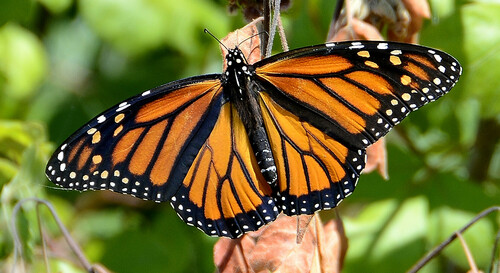
The monarch butterfly, or simply monarch, scientifically named Danaus plexippus (Linnaeus, 1758), is a milkweed butterfly belonging to the subfamily Danainae in the family Nymphalidae. Depending on the region, it also goes by the other common names milkweed, common tiger, wanderer, and black-veined brown. It is one of the most familiar butterflies in North America and is considered an iconic pollinator, though it is not a particularly effective pollinator of milkweed plants. Its wings have an easily recognizable black, orange, and white pattern, and it has a wingspan between 8.9–10.2 cm (3.5–4.0 in). The viceroy butterfly, a Müllerian mimic of the monarch, shares a similar color and pattern, but it is noticeably smaller and has an extra black stripe across each hindwing. The eastern North American monarch population is well known for its annual instinctive southward migration in late summer and autumn: it travels from the northern and central United States and southern Canada to Florida and Mexico. During this fall migration, monarchs travel thousands of miles, and the corresponding northward return in spring occurs across multiple generations. The western North American monarch population, found west of the Rocky Mountains, most often migrates to sites in southern California, but individuals from this population have also been recorded overwintering in Mexican sites. Additional monarch populations exist further south in the Americas, as well as in parts of Europe, Oceania, and Southeast Asia. The range of the western and eastern populations of D. p. plexippus expands and contracts with the changing seasons, and the range differs across breeding areas, migration routes, and winter roosts. However, there are no genetic differences between the western and eastern monarch populations, and reproductive isolation has not led to these populations becoming distinct subspecies, unlike what has happened in other parts of the species' range. In the Americas, the monarch's range extends from southern Canada through northern South America. It is also found in Bermuda, the Cook Islands, Hawaii, Cuba, and other Caribbean islands, the Solomons, New Caledonia, New Zealand, Papua New Guinea, Australia, the Azores, the Canary Islands, Madeira, continental Portugal, Gibraltar, the Philippines, and Morocco. It appears in the United Kingdom some years as an accidental migrant. Overwintering populations of D. p. plexippus are found in Mexico, California, along the Gulf Coast of the United States; they live year-round in Florida, and exist in Arizona where habitat meets the specific conditions needed for their survival. On the East Coast of the United States, they have overwintered as far north as Virginia Beach, Virginia. Their typical wintering habitat offers access to streams, abundant sunlight to maintain body temperatures that allow flight, suitable roosting vegetation, and is relatively free of predators. Overwintering roosting monarchs have been observed on basswoods, elms, sumacs, locusts, oaks, osage-oranges, mulberries, pecans, willows, cottonwoods, and mesquites. During the breeding season, monarchs can live in agricultural fields, pasture land, prairie remnants, urban and suburban residential areas, gardens, trees, and roadsides — any location that provides access to larval host plants. Declines in both milkweed abundance and monarch populations between 1999 and 2010 are correlated with the adoption of herbicide-tolerant genetically modified (GM) corn and soybeans, which now make up 89% of U.S. corn and 94% of U.S. soybeans. GM corn and soybeans are resistant to the effects of the herbicide glyphosate. Some conservationists link the disappearance of milkweed to Midwestern U.S. agricultural practices, where GM seeds are bred to resist herbicides that farmers use to remove unwanted plants growing alongside their food crops. In 2015, the Natural Resources Defense Council filed a lawsuit against the United States Environmental Protection Agency (EPA), arguing that the agency ignored warnings about the dangers of glyphosate usage for monarchs. However, a 2018 study has suggested that the decline in milkweed began before GM crops were introduced. In 2013, the area of Mexican forest that eastern and midwestern monarchs migrate to reached its lowest point in two decades, and the decline was expected to continue increasing during the 2013–2014 season. Mexican environmental authorities continue to monitor illegal logging of oyamel fir trees, but organized criminal groups have repeatedly disrupted these protection efforts for short-term financial gain. The oyamel fir is a major evergreen species that overwintering monarchs rely on for a large part of their winter diapause, or suspended development. A 2014 study acknowledged that while "the protection of overwintering habitat has no doubt gone a long way towards conserving monarchs that breed throughout eastern North America", their research shows that habitat loss on U.S. breeding grounds is the main cause of recent and projected population declines. Western monarch populations have rebounded slightly since 2014; the Western Monarch Thanksgiving Count recorded 335,479 monarchs in 2022, though the population still has a long way to go to fully recover. Like all Lepidoptera, monarchs go through complete metamorphosis, with a life cycle divided into four phases: egg, larva, pupa, and adult. Monarchs can develop from eggs to fully grown adults in as little as 25 days during warm summer temperatures, and development can take up to seven weeks in cool spring conditions. During development, both larvae and their milkweed host plants are vulnerable to extreme weather, predators, parasites, and diseases, and generally fewer than 10% of monarch eggs and caterpillars survive to adulthood. While monarch larvae only eat milkweed, adult monarchs feed on nectar from a wide range of plants. Publications have reported that Mexican sunflower (Tithonia rotundifolia) is especially attractive to adult monarchs. Monarchs also get moisture and minerals from damp soil and wet gravel, a behavior called mud-puddling. The monarch has also been observed puddling on an oil stain on pavement.