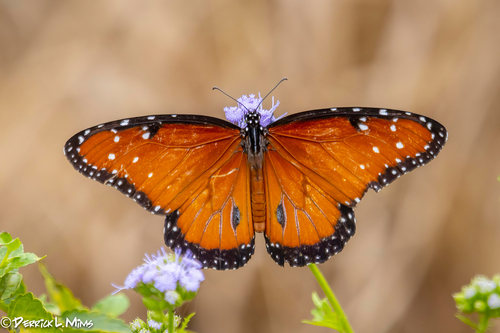
About Danaus gilippus (Cramer, 1775)
Life cycle and morphology: Female queen butterflies lay small white eggs one by one on larval host plants, which are usually members of the milkweed subfamily Asclepiadoideae. When the egg hatches, it produces a black caterpillar that has transverse white stripes, yellow spots, and three pairs of long black filaments. The caterpillar feeds on the host plant and sequesters chemicals that make it distasteful to some predators. It passes through five instars before the larva finds a suitable spot to pupate. The adult butterfly emerges 7 to 10 days after pupation, and the queen butterfly has multiple generations each year. Distribution and habitat: The queen butterfly is a member of the Danaidae family, which is common in both the New World and Old World. It is specifically found throughout the tropics and into the temperate regions of the Americas, Asia, and Africa, with stray specimens recorded in Europe. The queen is primarily a tropical species. In the United States, it is usually restricted to the southern portion of the country. It occurs regularly in peninsular Florida and southern Georgia, as well as in the southern parts of Texas, New Mexico, Arizona, and California. Occasionally, subspecies of the queen can be found further north, in Kansas, Colorado, and Utah. Periodically, stray individuals may be found in the Midwest, such as in Missouri. The berenice subspecies occurs largely in the Southeast, while the strigosus subspecies is found in the Southwest. The queen is also found in Cuba. It is more common in southern Central America, and its populations increase in Mexico. Queen butterflies can be found as far south as Argentina. Unlike the monarch butterfly, the queen does not undertake dramatic long-distance migrations, but most queens make short-distance trips at tropical latitudes in areas with a distinct dry season. During these dry periods, queens fly from lowlands to higher elevations. Across its entire distribution, the queen can be found on open land, in meadows, fields, and marshes. On Hispaniola, it shows a preference for more xeric, dry habitats, and will fly to the edges of hammocks and forests but rarely enters these areas. In the southern United States, the queen prefers open woodland, fields, and desert. Larval host plants and food sources: Queen larvae feed on plants in the Apocynaceae family, which includes milkweeds and dogbanes, and can survive on a number of different host plants. Common host plants include butterflyweed (Asclepias tuberosa) and bloodflower (Asclepias curassavica). In the West Indies, blunt-leaved milkweed (Asclepias amplexicaulis) and honey vine (Cynanchum laeve) are favored. Caterpillars have also been observed on Asclepias nivea, Calotropis procera, Asclepias humistrata, and Nerium oleander (listed here as Apocynaceae nerium). Other reported host genera include Apocynum, Cynanchum (including former Sarcostemma species), Gonolobus, and Stapelia. Adult food sources and host plants: As adults, queen butterflies have less specific feeding habits. They feed predominantly on nectar from flowers and dead foliage, but can also feed on rotting fruit, sweat, and both dry and wet dung, among other substances. Even as adults, queens are drawn to milkweeds in the Apocynaceae family. However, they are also attracted to plants in genera including Nerium, Funastrum, Vincetoxicum, Philabertia, and Stapelia. In addition to these food sources, male queens are attracted to Heliotropium, Eupatorium, Senecio, and Crotalaria—plants that contain the alkaloid lycopsamine. This alkaloid and other precursor compounds from these plants are used to create pheromones that attract mates. Pheromone precursors are predominantly obtained from plants in the Boraginaceae, Asteraceae, and Fabaceae families.