About Dama dama (Linnaeus, 1758)
Male fallow deer (Dama dama) are called bucks, females are called does, and young are called fawns. Adult bucks measure 140–160 cm (55–63 in) long, stand 85–95 cm (33–37 in) tall at the shoulder, and typically weigh 60–100 kg (130–220 lb). Adult does measure 130–150 cm (51–59 in) long, stand 75–85 cm (30–33 in) tall at the shoulder, and weigh 30–50 kg (66–110 lb). The largest recorded bucks can reach 190 cm (75 in) long and weigh up to 150 kg (330 lb). Fawns are born in spring, measuring around 30 cm (12 in) long and weighing 3–4 kg (6+1⁄2–9 lb). The species has a typical lifespan of 12–16 years.
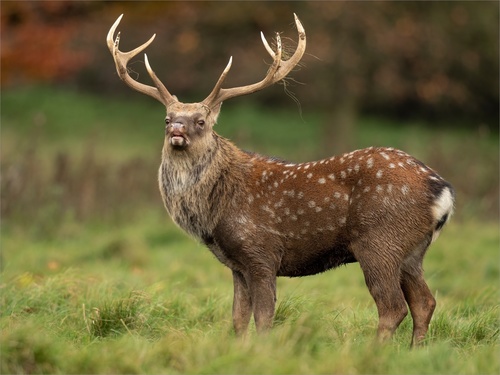
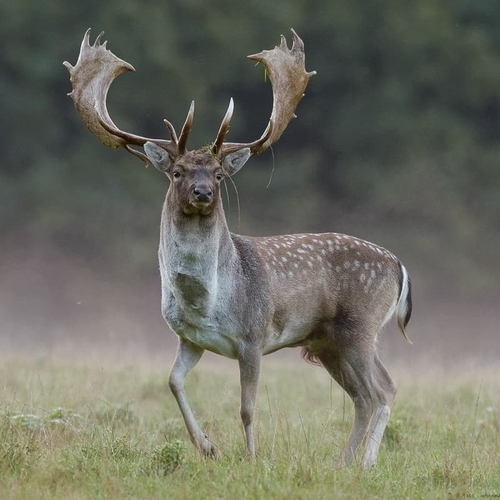
Coat colour in this species varies widely, with four main colour variants: common, menil, melanistic, and leucistic. Leucism is a true colour variant, not the same as albinism. Leucistic individuals are the lightest, appearing almost white; common and menil variants are darker, and melanistic individuals are very dark, sometimes fully black, and are easily confused with sika deer. The common variant has a chestnut coat marked with white mottles, which are most prominent in summer; in winter, the coat becomes much darker and loses its spots. It has a light-coloured area around the tail edged with black, and the tail itself is light with a black stripe. The menil variant has more distinct spots than the common variant in summer, and has no black markings around the rump patch or on the tail. Even in winter, its spots remain clear on a darker brown coat. The melanistic (black) variant has a black coat year-round that shades to greyish-brown, with no light-coloured tail patch and no spots. The leucistic (white, non-albino) variant has cream-coloured fawns; adults turn pure white, especially in winter, and retain dark eyes and a dark nose, with no spots on their coat.
Most herds are made up mostly of individuals with the common coat variant, but menil variant animals are not rare. The melanistic variant is generally rarer, and the white (leucistic) variant is much rarer still, though wild New Zealand herds often have a high percentage of melanistic individuals. Only bucks grow antlers: starting from three years of age, antlers are broad and shovel-shaped (palmate). In a buck's first two years, the antler is a single spike.
Fallow deer prefer mixed woodland and open grassland as their habitat. During the annual rut (mating season), bucks spread out, and females move between them, so fallow deer are relatively ungrouped during this period. The rest of the year, they stay together in groups that can number up to 150 individuals. When threatened, fallow deer are agile and fast, and can reach a maximum speed of 50 km/h (30 mph) over short distances. They are less muscular than other cervids such as roe deer, so they are not as fast as these related species. Fallow deer can also jump up to 1.75 m (5 ft 9 in) high and up to 5 m (16 ft) long.
The diet of the European fallow deer is highly flexible and can adapt to local conditions. A 1977 study of European fallow deer in Britain's New Forest found that these deer are selective mixed feeders. From March to September (spring and summer), they feed primarily on grass, with less consumption of herbs and browse. From September through late December (autumn), they feed primarily on acorns and other mast. In winter, their diet includes grass, plus shrubs such as brambles, bilberry, heather, and holly, as well as ivy and coniferous material.
Many deer species, including European fallow deer, have social organization that is highly plastic depending on environment: group size and herd size are closely linked to habitat type. Most detailed research into the ecological characteristics and behaviour of European fallow deer has been conducted in large blocks of woodland, so there may be some bias in current findings. European fallow deer can live in a wide variety of habitats ranging from cool and wet to hot and dry, and they appear to prefer older forests with dispersed areas of grass, trees, and varied other vegetation. Herds are largest right before the rutting season, while the smallest groups are females with fawns. For most of the year, the sexes remain separated, and only gather together during mating months, though other social patterns have also been observed, including bachelor groups and even mixed groups.
Male European fallow deer produce low-frequency vocalizations called groans. These groans come from the consistent, complex shape of the vocal tract, which includes both the oral and nasal cavities. During ruts, males work to gain the best possible territory to improve their chances of mating, and female deer are often present on these territorial stands. During this period, males stop feeding to defend their rutting areas from subordinate males. Males defending their territory lose an average of 17% of their body weight, and develop reversible steatosis of the liver. Males often return to the same rut across breeding seasons. In some cases, more than one individual can hold a single rut; possible reasons for this include high population density, limited available rut space, or higher-quality habitat that can be shared.
During the Last Interglacial (Eemian), around 130–115,000 years ago and earlier, European fallow deer were widely distributed across Europe, reaching as far north as the British Isles. During the Last Glacial Period (115,000–11,700 years ago), unfavourable climate conditions caused the species' range to collapse. It survived in refugia in Anatolia, and probably also in the Balkans and potentially other areas, though the fossil record for the species' distribution during this period is sparse.