About Dalea candida Willd.
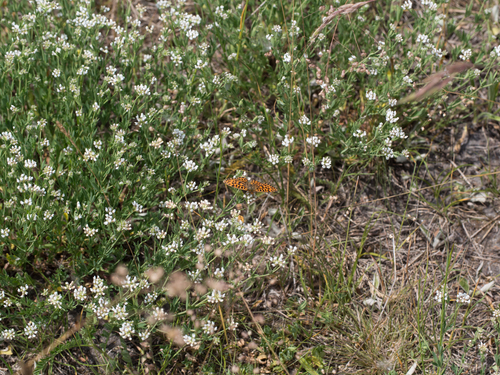
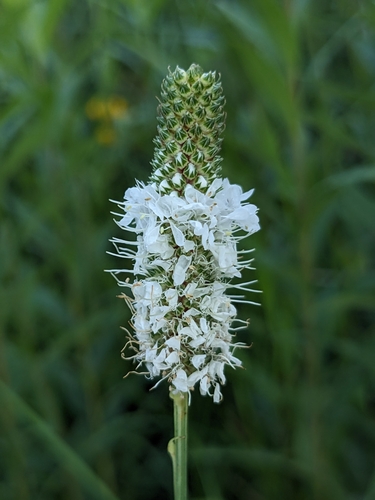
Dalea candida Willd., commonly known as white prairie clover, is a species of flowering plant in the legume family. It is native to North America, where it occurs across central Canada, the central United States, and northern Mexico. It can sometimes be found outside this native range as an introduced species. It grows in a wide variety of habitat types, including multiple types of prairie, foothills, woods, forests, and disturbed areas. It is a perennial herb that grows erect to a maximum height of around 1 meter (3 ft 3 in), and its taproot can reach 1.5 to 1.8 meters (5 to 6 feet) deep. Its alternately arranged leaves are each made up of several narrow, gland-dotted, light green leaflets. The inflorescence is a dense cylindrical spike of flowers that grows at the tip of each stem or stem branch. The spike is packed with pointed green calyces of sepals; lower calyces bear white-petaled corollas, and higher buds bloom later. The fruit is a green oval legume pod that holds one seed. A specimen of this species was collected by Meriwether Lewis in Nebraska in 1804. In ecology, this species is popular with pollinators. As a legume, it fixes nitrogen, and the USDA classifies it as a "high" nitrogen fixer, a category that includes very few native North American plants. It acts as a larval host for the clouded sulphur, marine blue, Reakirt's blue, and southern dogface butterflies. For traditional uses, the candida variety of this plant is used by the Ramah Navajo people to treat stomachache and as "life medicine", particularly to reduce fever. A compound decoction of the plant is also used to treat "snake infection" in sheep.