About Dahlia imperialis Roezl
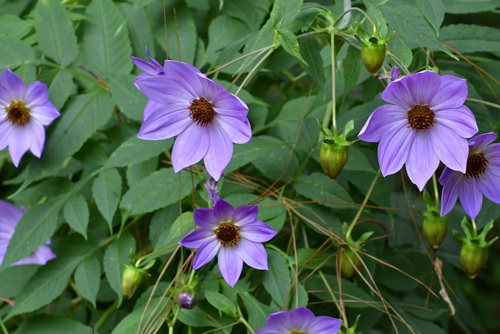
Dahlia imperialis Roezl is a herbaceous perennial that grows 8 to 10 meters (26 to 33 feet) tall. It has an annual dormant winter period, which is shorter in mild climates, and begins rapid new growth from its tuber each spring. From its underground base, it produces hollow, cane-like four-sided stems with swollen nodes and large tripinnate leaves; foliage near the ground is shed early in the growing season. Its nodding or pendant flowerheads measure 7.5 to 15 centimeters (3 to 6 inches) across, and their ray florets are typically colored lavender or mauvish-pink. This species is native to Mexico, Belize, Guatemala, Honduras, El Salvador, Nicaragua, Costa Rica, and Panama, and ranges south into Colombia and Ecuador. It grows in upland areas, most commonly in the foothills of subtropical or tropical mountains at elevations between 1,500 and 1,700 meters (4,900 and 5,600 feet), above the high humidity of lower elevation forests. It is fast-growing, with its growth spurt triggered by shorter daylight hours, and typically blooms in autumn before the first frost risk. It can be propagated either by seed or by stem cuttings. Cuttings for propagation are around 30 centimeters (12 inches) long, have at least two nodes, and are laid horizontally 5 to 10 centimeters under the soil. An optional top-dressing of pea gravel, decomposed granite, or grit helps retain moisture, prevent erosion, and improve drainage. Like many other tuberous dahlias, its tubers can be prepared and eaten similarly to potatoes or cooked carrots. Its petals may be added to green salads or soups, and the Q'eqchi' people of San Pedro Carchá, Alta Verapaz, Guatemala use its leaves as a dietary supplement.