About Dactylotum bicolor Charpentier, 1845
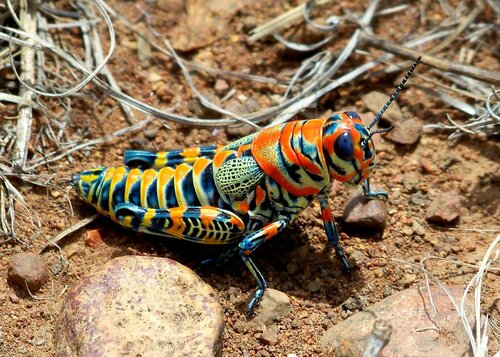
Dactylotum bicolor, first described by Charpentier in 1845, reaches an average length of around 20 mm (0.8 in) for males and 35 mm (1.4 in) for females. Its body is mostly black, with distinctive reddish and yellowish markings, plus a pale green prothorax and pale green wingpads. The tibia of the hind leg has six to eight spines. This species does not develop functional wings and cannot fly. Three subspecies of Dactylotum bicolor are currently recognized. D. b. bicolor occurs in Northern Texas, New Mexico and Mexico; D. b. pictum is found in the northern and eastern part of the species' overall range; D. b. variegatum occurs in Southern Arizona and the western part of the range. Coloring varies across the species' range: D. b. pictum is black with very little red, D. b. variegatum has clearly visible red markings, and D. b. bicolor has a purplish or violet sheen on its black base color. Before Dichroplus silveiraguidoi was discovered in Uruguay in 1956, Dactylotum bicolor had the lowest known chromosome count of any grasshopper species, with seventeen acrocentric chromosomes. This species is distributed across shortgrass prairie, desert grasslands, thinly vegetated areas and alfalfa fields. Its range extends throughout the western Great Plains of the United States (and southern Canada), south to Arizona, New Mexico, Texas, and into northern Mexico.