About Dactylopsila trivirgata Gray, 1858
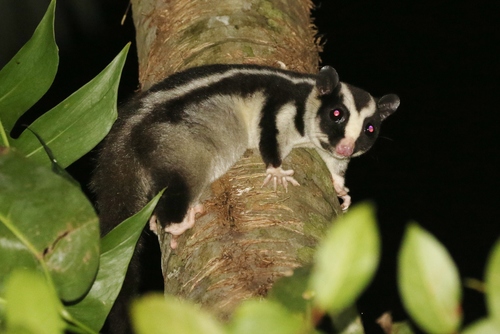
This species, Dactylopsila trivirgata, is commonly known as the striped possum. It has a black and white appearance resembling a squirrel. It is a solitary, mostly nocturnal, arboreal marsupial that builds nests in tree branches. Its approximate body length is 263 mm, its tail is around 325 mm long, and its average weight is 423 g. The striped possum has a prehensile tail. Its fourth finger is elongated compared to its other fingers, similar to the third finger of the aye-aye, a lemur native to Malagasy rainforests. This elongated finger is used to pull beetles and caterpillars out of tree bark, leading the species to be called a "mammalian woodpecker". The main diet of the striped possum is wood-boring insect larvae. To get these larvae, it rips open tree bark with its powerful incisor teeth, then probes rotten branches with its elongated fourth finger to expose the insects. It detects larvae by rapidly drumming along branches with the toes of its forefoot. The fourth finger has an unusual hooked nail that it uses to pull insects out of cracks. The striped possum also eats leaves, fruits, and small vertebrates. It produces a very powerful, unpleasant smell, and it is noisy and known to growl. During the day, it curls up to sleep on an exposed branch. Female striped possums have two teats in their pouch and can give birth to up to two young, though little is known about this species' breeding habits. It is most easily detected by the sound of its chewing and drinking as it moves through the forest. The striped possum is one of the least studied and understood marsupials. The species is not considered to be threatened. Its range includes New Guinea, several nearby small islands including the Solomon Islands, and the east coast of Cape York Peninsula in Queensland, Australia, where it lives in rainforests and eucalypt woodland as far south as Townsville. In Australia, the species is uncommon and rarely seen.