About Dactylopius opuntiae (Cockerell, 1896)
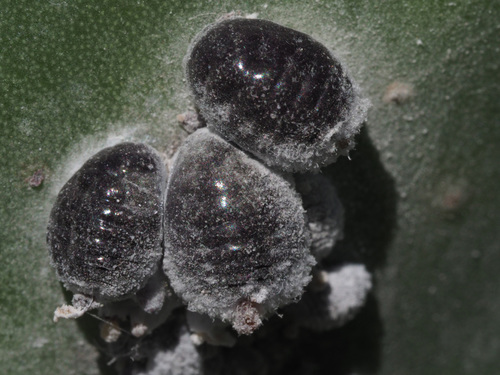
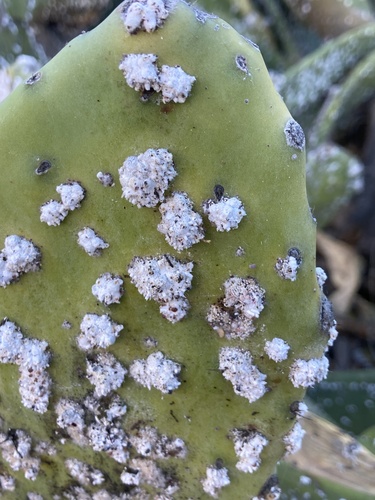
All species in the family Dactylopiidae have female individuals with an oval, purple-red body covered in white cotton-like wax. This wax protects the cochineal’s body from heat, cold, and predators. Adult females are sessile, and form colonies that can include up to a few thousand individuals of mixed age, creating visible clusters of white wax across the entire plant. Adult females of Dactylopius opuntiae naturally produce carminic acid, a red glucosidal hydroxyanthrapurin, within their bodies. All Dactylopius species share specific morphological traits: females have truncate dorsal setae, clusters of quinquelocular pores associated with tubular ducts on their bodies, no microducts, and no cellular anal rings that bear setae. Dactylopius opuntiae can be distinguished from all other species in its genus by its large, truncate, rounded setae that are longer than their base width, plus numerous narrow ventral pores on the last three body segments. Dactylopius opuntiae is native to Mexico and neighboring countries of Central America, but has been introduced to many other regions. These introduced areas include Australia, Algeria, Morocco, Israel, France, India, Kenya, Madagascar, Pakistan, South Africa, Sri Lanka, and the United States (California and Texas). Like other members of the Dactylopiidae family, Dactylopius opuntiae is not affected by parasitoid wasps. In its native Mexico, the most common predators of this species are Leucopis bellula, Sympherobius barberi, and Laetilia coccidivora. Dactylopius opuntiae is used as a biological control agent for invasive cacti. In 1932, it was introduced to South Africa alongside three other insect species to control invasive cactus. It cleared 75% of infested areas, including the most heavily opuntia-infested sites. After this successful control effort, around 90% of the original 900,000 hectares of infested land was returned to sheep rearing. However, dense prickly pear populations still remain in cold, rainy regions, which are not favorable for Dactylopius opuntiae development. A later introduction of Dactylopius opuntiae to Kruger National Park in the mid-1990s failed to control Opuntia stricta, confirming the importance of matching specific biotypes of biological control agents to their target host plants for effective weed control. A new strain of the cochineal, collected from Opuntia stricta in Australia, was introduced in 1997 and produced encouraging results. The Dactylopius opuntiae genotype that successfully controlled Opuntia stricta in South Africa was also introduced to Kenya, where it reduced flowering and fruiting of the cactus and killed existing plants. De Souza & Hoffmann (2015) assessed the performance of Dactylopius opuntiae in controlling Opuntia monacantha, and found that it was less efficient than the related species Dactylopius ceylonicus, which provides complete biological control of this cactus. Rule & Hoffmann (2018) investigated the effectiveness of the 'stricta' biotype of Dactylopius opuntiae as a biological control agent for both Opuntia humifusa and Opuntia stricta. Their semi-field experiment found that Dactylopius opuntiae can develop equally well on both host plant species. Researchers also assessed the dispersal capability of Dactylopius opuntiae away from initial inoculation sites to promote faster spread of the scale insect. They found that inoculation colonies should be placed no more than 10 meters apart, because cochineal spread primarily occurs via wind. The effectiveness of Dactylopius opuntiae is often limited by predatory coccinellids, and to an even greater degree by rain. In South Africa, the success of Dactylopius opuntiae as a biological control agent reduced prickly pear’s status as a weed, and this has led to increased use of prickly pear for human consumption, as livestock forage, and as a host plant for rearing Dactylopius coccus. However, Dactylopius opuntiae can also cause severe negative impacts on production of prickly pear fruit for fresh consumption, and on prickly pear cladodes used as livestock fodder. This cochineal species forms colonies of variable size on cladodes, and in some cases completely covers the cladodes. This causes fruits to drop, and cladodes to dry out and fall off.