About Dactylopius coccus Costa, 1829
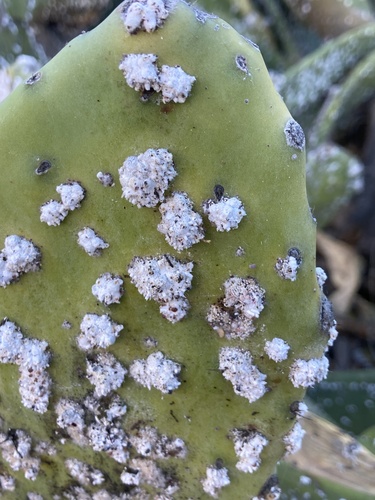
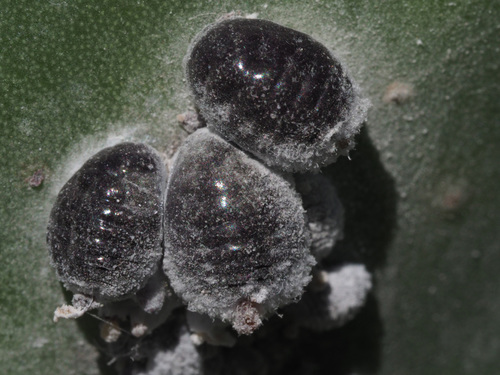
Dactylopius coccus Costa, 1829, commonly called cochineal, is a scale insect in the suborder Sternorrhyncha, and the natural dye carmine is derived from this species. This species is a primarily sessile parasite native to tropical and subtropical regions ranging from South America through North America, specifically Mexico and the Southwest United States. It lives on cacti of the genus Opuntia, feeding on cactus moisture and nutrients. The insects are found on the pads of prickly pear cacti; they are collected by brushing them off the plants, then dried. The insect produces carminic acid, which deters predation by other insects. Carminic acid typically makes up 17–24% of the weight of dried insects, and can be extracted from the insect's body and eggs. It is then mixed with aluminium or calcium salts to make carmine dye, which is also known as cochineal. Today, carmine is primarily used as a colorant in food and in lipstick, where it is labeled E120 or Natural Red 4. Carmine dye was used in the Americas for coloring fabrics, and became an important export good in the 16th century during the colonial period. The production of cochineal is depicted in the 1565 Codex Osuna. After synthetic pigments and dyes such as alizarin were invented in the late 19th century, the use of natural-dye products like cochineal gradually diminished. Fears over the safety of artificial food additives renewed the popularity of cochineal dyes, and increased demand has made cultivation of the insect profitable again. Peru is the largest producer of cochineal today, followed by Mexico, Chile, Argentina and the Canary Islands. Other species in the genus Dactylopius can also be used to produce "cochineal extract", and they are extremely difficult to distinguish from D. coccus, even for expert taxonomists. Because of this, the scientific term D. coccus and the common name "cochineal insect" are sometimes used to refer to other species, either intentionally or casually, which can be misleading. Cochineal insects are soft-bodied, flat, oval-shaped scale insects. Females are wingless, around 5 mm (0.20 in) long, and cluster on cactus pads. They penetrate the cactus with their beak-like mouthparts to feed on cactus juices, and remain immobile unless alarmed. After mating, the fertilised female increases in size and gives birth to tiny nymphs. The nymphs secrete a waxy white substance over their bodies to protect against water loss and excessive sun. This waxy coating makes the cochineal insect appear white or grey from the outside, though the body of the insect and its nymphs produces the red pigment that makes the insect's insides look dark purple. Adult males can be easily distinguished from females: males have wings, and are much smaller than females. Cochineal disperses during the first nymph stage, called the "crawler" stage. Juvenile crawlers move to a feeding spot and produce long wax filaments. Later, they move to the edge of the cactus pad, where wind catches the wax filaments and carries the insects to a new cactus host. These individuals establish feeding sites on the new host and produce a new generation of cochineals. Male nymphs feed on the cactus until they reach sexual maturity. Once mature, they can no longer feed at all, and only live long enough to fertilise eggs. Because of this, males are seldom observed. Females also typically outnumber males due to environmental factors. Prior to the Spanish invasion, Aztecs used cochineal pigments in their manuscripts. The 16th century Florentine Codex contains a variety of illustrations that use multiple variations of the red cochineal pigment. Technical analysis of the light red shade achiotl reveals multiple layers of the pigment, even though the layering is not visible to the naked eye. This shows that the process of applying multiple layers is more significant than the color itself. Layering different hues of the same pigment on top of each other allowed Aztec artists to create variations in the intensity of the subject matter. A bolder application of pigment draws the viewer's eye to the subject to command attention, and suggests a power relationship with the viewer. A weaker application of pigment commands less attention and has less power. This suggests that the Aztec associated the intensity of pigments with the ideas of power and life. Pigments are insoluble finely ground particles that are mixed with a liquid to make paint. To be useful as a pigment, a substance must be insoluble in the liquid it is mixed with, which contrasts with a dye that is soluble. The performance of carmines can vary widely depending on their preparation and composition: they tend to be unstable, and their solubility can change depending on pH. Recipes for artists' use of crimson appear in many early medieval painting and alchemical handbooks. Red lake pigments were known to be particularly unstable as early as the 1400s. When cochineal lakes were introduced in Europe, artists soon found that they were not light-fast. The paint turns brown and fades in sunlight, though it is somewhat more permanent when mixed with oil rather than watercolor. As a result, use of carmine as a pigment was discouraged, and its primary use became as a dye rather than in paints. As chemist Arthur Herbert Church stated: "Beautiful and rich as are the colours prepared from cochineal, not one of them should ever find a place upon the palette of the artist. They all become brownish and ultimately almost disappear after a short exposure to sunlight or the more prolonged attack of strong diffused daylight". Cochineal continues to be used as a fabric dye, cosmetics dye, and food coloring. It is also used in histology as a preparatory stain for the examination of tissues and carbohydrates. As of 2005, Peru produced 200 tons of cochineal dye per year and the Canary Islands produced 20 tons per year. Chile and Mexico also export cochineal. France is believed to be the world's largest importer, and Japan and Italy also import the insect. Much of these imports are processed and re-exported to other developed economies. As of 2005, the market price of cochineal was between US$50 and 80 per kilogram, while synthetic raw food dyes are available at prices as low as $10–20 per kilogram. Natural carmine dye used in food and cosmetics makes affected products unacceptable to vegetarian or vegan consumers. Many Muslims consider food containing carmine forbidden (haraam), because the dye is extracted from insects, and all insects except locusts are haram in Islam. Jews also avoid food containing this additive, though it is not treif, and some authorities allow its use because the insect is dried and reduced to powder. Cochineal is one of the few water-soluble colorants that resist degradation over time. It is one of the most light- and heat-stable, oxidation-resistant of all natural organic colorants, and is even more stable than many synthetic food colors. The water-soluble form, cochineal extract, is used in a wide variety of beverages; the insoluble form, carmine, is used in a wide variety of products. These products include meat, sausages, processed poultry products (in the United States, meat products cannot be colored unless the coloring is labeled), surimi, marinades, alcoholic drinks, bakery products and toppings, cookies, desserts, icings, pie fillings, jams, preserves, gelatin desserts, juice beverages, varieties of cheddar cheese and other dairy products, sauces, and sweets. Carmine is considered safe enough for cosmetic use in the eye area. A significant proportion of the insoluble carmine pigment produced is used in the cosmetics industry for hair- and skin-care products, lipsticks, face powders, rouges, and blushes. A bright red dye and the stain carmine used in microbiology is also often made from carmine extract. The pharmaceutical industry uses cochineal to color pills and ointments. Cochineal-colored wool and cotton continue to be important materials for Mexican folk art and crafts. Some towns in the Mexican state of Oaxaca still follow traditional practices of producing and using cochineal when making handmade textiles. In Guatemala, Heifer International has partnered with local women who wanted to reintroduce traditional artisanal practices of cochineal production and use. Because cochineal has a complicated structure with multiple chemical groups, it is very difficult to create a synthetic carminic acid molecule. In 1991, carminic acid was first synthesized in a laboratory by organic chemists. In 2018, researchers genetically engineered the fungus Aspergillus nidulans to produce carminic acid; the bacterium Escherichia coli was engineered to produce carminic acid in 2021.