About Dacrycarpus dacrydioides (A.Rich.) de Laub.
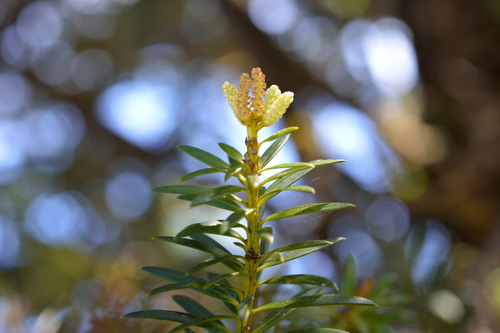
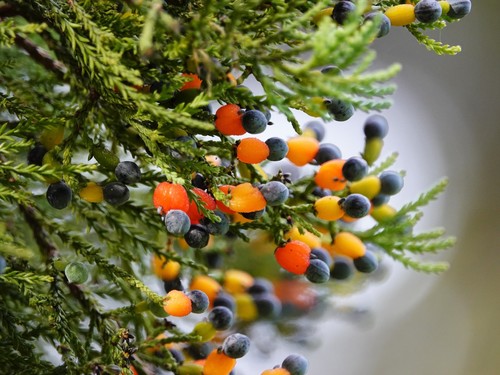
Dacrycarpus dacrydioides, commonly called kahikatea, is a coniferous tree native to New Zealand. It grows 50 to 65 meters (164 to 213 feet) tall, with a trunk 1 to 2 meters (3.3 to 6.6 feet) thick, making it the tallest tree species in New Zealand. It has a maximum lifespan of 600 years, and reaches maturity between 250 and 450 years of age. Near its base, the roots are typically buttressed and grooved. When adult trees grow in clusters, they develop interlocking root islands that may help prevent individual trees from falling during strong winds. The wood of kahikatea is odourless and white. Around three-quarters of an adult kahikatea’s trunk is branchless, and it is covered in grey or dark grey bark that peels away in thick flakes. Young adult trees have no branches along one-third to one-half of their trunk, and have a conical growth form. Juvenile kahikatea have leaves that measure 3 to 7 mm long, or up to 4 mm in young adults, and 0.5 to 1 mm wide; these leaves are dark green to red, end in a distinct sharp point, are narrow, arranged in nearly opposite pairs spreading from a wider base, and curved like a scythe. Adult leaves are dramatically different: they are brown-green, just 1 to 2 mm long, waxy, and grow tightly overlapping one another. As a conifer, kahikatea does not produce flowers, and instead bears separate male and female cones on different individual trees. Male cones are 1 cm long and rectangular in shape. Its pollen is pale yellow, and has a distinctive three-pored (trisaccate) shape that makes it easily identifiable among New Zealand flora. Its reproductive structure is a highly modified cone that resembles a fruit: it has a yellow-orange fleshy receptacle 2.5 to 6.5 mm long, a roughly spherical purple-black seed 4 to 6 mm in diameter, and both the seed and ovary are covered in a thin layer of wax. Kahikatea has a diploid chromosome count of 20. This species is endemic to the North, South, and Stewart Islands of New Zealand, and it is the only member of the genus Dacrycarpus that occurs in the country. It grows mostly in lowland forests between 0 and 600 m (0 to 1,969 ft) above sea level, and only rarely reaches montane areas. Historically, kahikatea dominated a distinct swamp forest ecosystem that now survives almost exclusively in the South Westland region of New Zealand’s South Island. It prefers flooded or alluvial soils with poor drainage, which formed in Westland after glaciation events. Under ideal growing conditions, a mature kahikatea can produce 800 kilograms (1,800 lb) of fruit (equal to 4.5 million seeds) per year. The fleshy receptacle of the fruit attracts native New Zealand birds including kererū, tūī, and bellbird, which eat the fruit and disperse the seeds to new locations. A 2008 study published in the New Zealand Journal of Ecology found the mean retention time of kahikatea seeds in kererū is 44.5 minutes. A 1989 study suggested that the receptacle’s high water content may help protect kahikatea seeds, which are vulnerable to drying out, from dry conditions, and may also act as a water storage structure. Kahikatea seeds have strong UV reflectance that is visible to some bird species. Mature kahikatea trees support a large community of non-parasitic epiphyte plants growing on their branches. A 2002 study found 90 to 100 epiphyte species growing on a single mature kahikatea, including 49 vascular plants and over 50 non-vascular plants; this species count was found to be comparable to the epiphyte diversity found on individual Prumnopitys exigua trees in Bolivian cloud forest. A 1999 study found intraspecific competition between kahikatea trees is an important factor influencing their survival and overall fitness, affecting both growth and mortality rates. Older trees have a large advantage accessing resources compared to younger trees, and also have faster growth rates. After flooding or other natural disturbance events, kahikatea requires an open canopy to re-establish itself. In South Westland, these disturbance events occur consistently, so many forest areas do not progress beyond regrowth of kahikatea and rimu; other species such as kāmahi cannot return until environmental conditions improve. Kahikatea is host to the New Zealand endemic beetle Agapanthida pulchella, and is the primary host of the lichen Ramalina erumpens. In November 1769, after visiting the Waihou River area, Captain James Cook praised kahikatea, believing it would be an excellent source of masts and timber for ships. This assessment led to an early shipbuilding industry in the late 18th and early 19th centuries, where European ships travelled to the Waihou River area to trade for kahikatea timber, even though the wood absorbs water easily and is not actually suited for ship masts and timber. By the 1820s, kauri timber had replaced kahikatea for this use. During the 19th century, kahikatea’s soft, odourless wood was processed into pulp, barrels, and boxes—most notably butter boxes for exported butter sent to the United Kingdom—and was occasionally used to make furniture.