About Dacelo novaeguineae (Hermann, 1783)
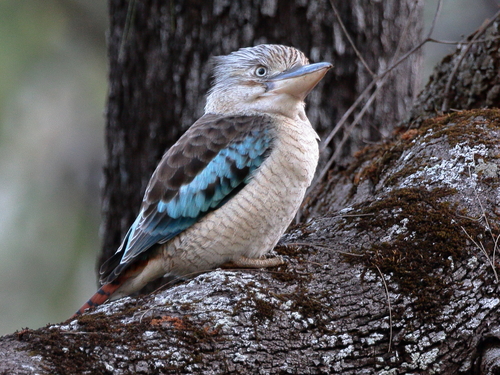
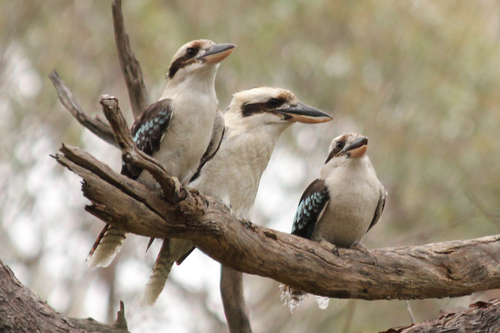
The laughing kookaburra, scientifically named Dacelo novaeguineae (Hermann, 1783), is the largest kingfisher species, with a greater body mass than even the giant kingfisher. It is a stout, stocky bird measuring 41–47 cm (16–19 in) in length, with a large head, prominent brown eyes, and a long, robust bill. The sexes look very similar, though females are usually larger and have less blue coloring on the rump than males. Males weigh 196–450 g (6.9–15.9 oz), with an average weight of 307 g (10.8 oz), while females weigh 190–465 g (6.7–16.4 oz), with an average weight of 352 g (12.4 oz). Their body and head are white or cream-colored, with a dark brown stripe running across each eye, and a fainter dark brown stripe over the top of the head. Their wings and back are brown, with sky blue spots on the shoulders. Their tail is rusty reddish-orange with dark brown bars and white tips on the feathers. Their heavy bill is black on the upper mandible and bone-colored on the lower mandible. The subspecies D. n. minor has plumage nearly identical to the nominate subspecies, but is smaller in overall size. The laughing kookaburra can be told apart from the similarly sized blue-winged kookaburra by its dark eye, dark eye-stripe, shorter bill, and smaller, duller blue areas on the wing and rump. Male blue-winged kookaburras also differ by having a barred blue and black tail.
The laughing kookaburra is native to eastern Australia, where its range stretches from the Cape York Peninsula in the north to Cape Otway in the south. It occurs on both the eastern and western sides of the Great Dividing Range. In the southern part of its native range, its distribution extends west from Victoria to the Yorke Peninsula and the Flinders Ranges in South Australia. It has been introduced to many other areas, likely because of its reputation for killing snakes. In December 1891, the Western Australian parliament added 'Laughing Jackass' to the schedule of strictly preserved Australian native birds in the Game Bill introduced by Horace Sholl, the member for North District. Sholl described the bird as native to the North West, so his nomination definitely refers to the blue-winged kookaburra (Dacelo leachii), not the laughing kookaburra (Dacelo novaeguineae). The 1892 Western Australian Game Act, titled "An Act to provide for the preservation of imported birds and animals, and of native game," allowed proclaimed Australian native birds and animals listed in the Act's First Schedule to be declared protected from being taken. Laughing Jackass was one of 23 Australian native bird species named in the schedule. Laughing kookaburras from eastern Australian states were released in southwestern Western Australia as early as 1883, and birds were recorded between Perth and Fremantle, as well as inland near Mullewa around 1896. The Western Australian Acclimatization Society, also called the Animal and Bird Acclimatization committee of WA, imported and released hundreds of laughing kookaburras between 1897 and 1912. Most releases were led by Ernest Le Souef, who was Secretary of the Acclimatization Society and Director of Perth Zoological Gardens. Le Souef was an enthusiastic supporter of introducing kookaburras, and admitted to releasing hundreds from the zoo, including 50 releases in 1900 at the royal request of the visiting Duke of York. By 1912, established breeding populations existed in multiple areas of southwestern Western Australia. The species' current range in Western Australia lies southwest of a line connecting Geraldton on the west coast and Hopetoun on the south coast.
In Tasmania, the laughing kookaburra was introduced at multiple locations starting in 1906. It now occurs mainly northeast of a line connecting Huonville, Lake Rowallan, Waratah and Marrawah. It was introduced to Flinders Island around 1940, where it is now widespread, and to Kangaroo Island in 1926. In the 1860s, during his second term as governor of New Zealand, George Grey arranged for the release of laughing kookaburras on Kawau Island. Kawau Island is located in the Hauraki Gulf, approximately 40 km (25 mi) north of Auckland on New Zealand's North Island. The introduction was originally thought to have failed, but some birds were discovered on the adjacent mainland in 1916. The species now breeds in a small area on the western side of the Hauraki Gulf, between Leigh and Kumeu.
The laughing kookaburra's typical habitat is open sclerophyll forest and woodland. It is more common in areas with an open, sparse understory, or where the ground is covered in grass. Tree holes are required for nesting. It also occurs near wetlands, in partly cleared areas, and in farmland with trees growing along roads and fences. In urban areas, it can be found in parks and gardens. The range of the laughing kookaburra overlaps with the range of the blue-winged kookaburra in an area of eastern Queensland that extends from the Cape York Peninsula south to near Brisbane. Around Cooktown, the laughing kookaburra tends to prefer areas near water, while the blue-winged kookaburra occupies drier habitats. One individual laughing kookaburra has been recorded in the English county of Suffolk since at least 2015, and was most recently sighted in 2024. Additional sightings of the species have been recorded in Scotland, which suggests that these individuals may have been intentionally or accidentally released into the wild in the United Kingdom.