About Dacelo leachii Vigors & Horsfield, 1827
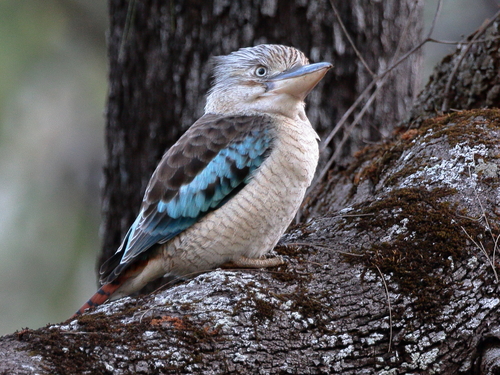
The scientific name of the blue-winged kookaburra is Dacelo leachii Vigors & Horsfield, 1827. Adult blue-winged kookaburras measure around 38 to 42 cm (15 to 17 inches) in length, and weigh 260 to 330 grams. Compared to the closely related laughing kookaburra, the blue-winged kookaburra is smaller, lacks a dark facial mask, has more blue coloration on its wings, and has distinct striking white eyes. It has a heavier bill than the larger laughing kookaburra. Its head and underparts are cream-colored with brownish streaks. This species is sexually dimorphic: males have blue tails, while females have rufous tails marked with blackish bars. Immature blue-winged kookaburras have more prominent brown bars and markings across their plumage, which gives them a "dirty" appearance, and their eyes are predominantly brown for the first two years of life. The species' call has been described as maniacal cackling or barking. The blue-winged kookaburra is distributed across southern New Guinea, the moister regions of northern Australia, across the Top End to the Brisbane area of southern Queensland, and south along the Western Australian coast to the Shark Bay region. It does not occur in the area between Broome and Port Hedland in northwestern Australia. It is widespread and common throughout its large range, and is currently evaluated as Least Concern on the IUCN Red List of Threatened Species. It lives in family groups of up to 12 individuals, and occupies open savannah woodland, Melaleuca swamps, and farmlands such as sugarcane plantations.