About Dacelo gaudichaud Gaimard, 1823
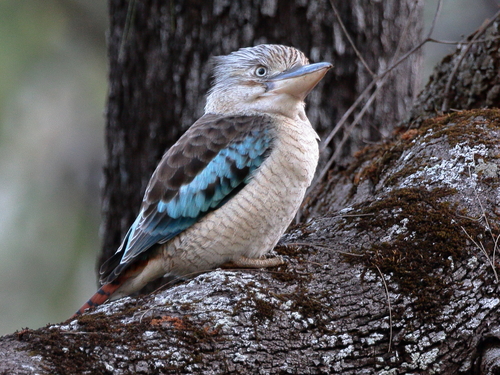
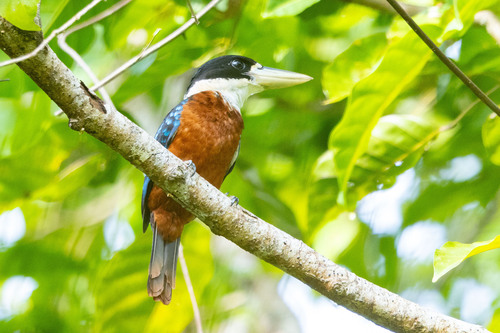
The rufous-bellied kookaburra, scientifically known as Dacelo gaudichaud, was originally called Gaudichaud's kookaburra, named after French botanist Charles Gaudichaud-Beaupré. This kookaburra species is widely distributed across the lowland forests of New Guinea. It has a black cap, blue-tinged wings, and pale rufous belly and tail feathers. Its most distinctive feature is a white bill, which clearly separates it from other kookaburras, which all have black bills; juvenile rufous-bellied kookaburras, however, have dark grey bills. Similar to the blue-winged kookaburra, this species can be sexed by the color of the tail feathers: male rufous-bellied kookaburras have blue tails, while females and immature birds have rufous tails. The rufous-bellied kookaburra is smaller than all other kookaburra species. Adults average around 28 cm (11.0 in) long and weigh around 143 g (5.0 oz), compared to the laughing kookaburra which reaches 46 cm (18.1 in) in length and 335 g (11.8 oz) in weight. Despite this large difference in size, the rufous-bellied kookaburra is known to form infertile hybrids with all other kookaburra species. Available genetic studies indicate that it is the most genetically distant of the four recognized kookaburra species. Unlike other kookaburras, which prefer open habitats, the rufous-bellied kookaburra uniquely lives in dense rainforests. It does not live in cooperative breeding family groups like other kookaburras; instead, it lives alone, or as a breeding pair during the breeding season. This species occupies the middle story of tropical rainforest. It perches in the middle story, then flies directly and swiftly out to capture large insects from tree surfaces. Even though it flies directly toward prey, it is able to make very sharp twists and turns to navigate the dense trees of its rainforest habitat. It will also hunt small vertebrates, though it does this less often than larger woodland kookaburra species. When it preys on the eggs or nestlings of smaller bird species, smaller birds frequently mob it. Males are highly aggressive when defending their territories, which average 2 to 2.5 hectares (4.9 to 6.2 acres) in size, and they will sometimes fight intruding individuals violently. Like their larger kookaburra relatives, rufous-bellied kookaburras breed inside termite mounds. Breeding activity typically occurs between May and October. Young do not fully disperse from their parents' territory until February, and breeding pairs have never been recorded attempting a second brood within a single year. Females lay two white eggs per clutch, though the exact incubation period for this species is not known.